
Understanding Vitamin E: Benefits and Forms Explained
Discover the truth about vitamin E and its benefits. Learn what vitamin E really is, the different forms available, and why it matters for your health and skin. Uncover the misconceptions surrounding this essential nutrient.
FATTY LIVER DISEASEANTI-AGEINGCANCERCARDIOVASCULAR HEALTHIMMUNE SYSTEMLONGEVITYCANCER PREVENTIONMETABOLIC HEALTHTYPE 2 DIABETESANNATTO TOCOTRIENOLBRAIN HEALTHINFLAMMATIONCELLULAR HEALTH
Natural Health Connect Research
5/23/20265 min read
New to this topic? Start with our foundational article:
"Understanding Oxidative Stress and Chronic Disease." (Read it here)
Then read - "GG - The Essential Molecule You Need More Of After 50"
Vitamin E Is Not What You Think It Is
Ask most people what Vitamin E does, and they'll say something like "it's an antioxidant, good for your skin." Ask them which form of Vitamin E is most effective, and they'll look blank, because most people (and many healthcare practitioners) don't know that Vitamin E is not a single compound at all.
Vitamin E is a family of eight related molecules, four tocopherols and four tocotrienols, each in alpha, beta, gamma and delta forms. For decades, virtually all research and supplementation focused on alpha-tocopherol, the most abundant form in the Western diet and the form used in almost all standard Vitamin E supplements.
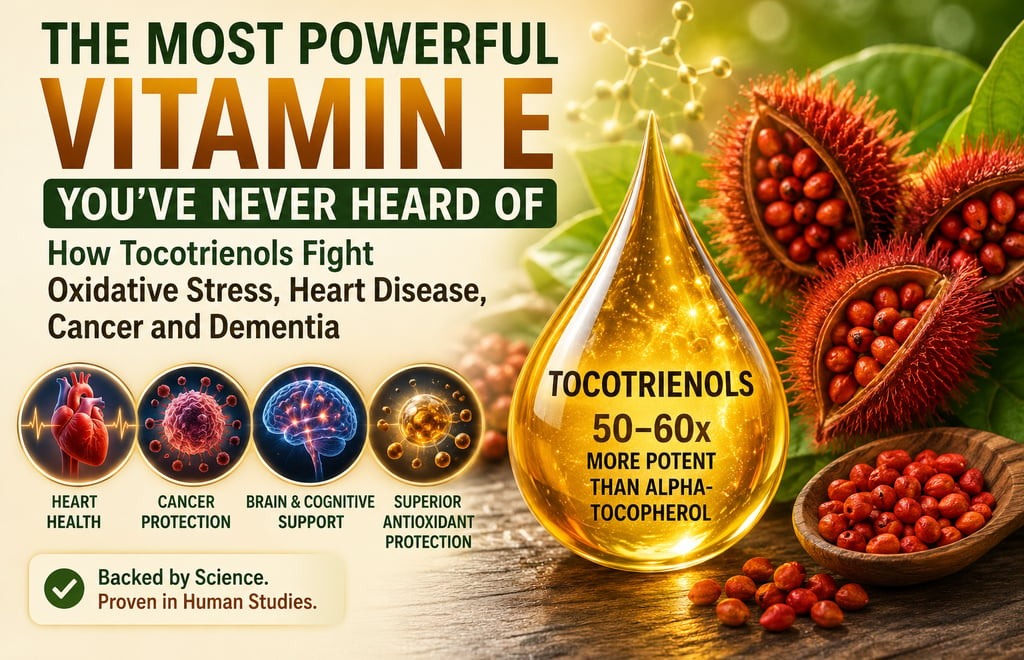
What science has since discovered is that this focus was a profound mistake. The tocotrienol forms of Vitamin E ,particularly delta (δ) and gamma (γ) tocotrienols, are dramatically more potent, more biologically active and therapeutically more powerful than alpha-tocopherol in almost every application studied.
Most people have never heard of them. That is about to change.
What Makes Tocotrienols Different?
Tocotrienols and tocopherols share the same core chemical structure, a chromanol ring, but differ in one critical way - the molecular tail. Tocopherols have a saturated (rigid) phytyl tail, while tocotrienols have an unsaturated (flexible) farnesyl tail with three double bonds.
This structural difference has profound biological consequences:
50–60× more potent as antioxidants than alpha-tocopherol in cellular membranes - the flexible tail allows tocotrienols to move rapidly and uniformly through the membrane bilayer, covering far more territory and neutralising far more free radicals per molecule
Deeper, faster membrane penetration - tocotrienols insert themselves more efficiently into cell membranes, precisely where the most damaging lipid peroxidation chain reactions originate
Unique gene-signalling capabilities - tocotrienols modulate critical gene expression pathways (including NF-κB, the body's master inflammatory switch) in ways that tocopherols simply cannot
Anti-tumour activity - tocotrienols trigger programmed cancer cell death (apoptosis) through mechanisms entirely absent from tocopherols
A 2024 systematic review directly comparing tocotrienols and tocopherols in cardiovascular outcomes confirmed the superior efficacy of tocotrienols, finding meaningful reductions in total cholesterol, LDL-cholesterol, triglycerides and inflammatory markers that tocopherols failed to match.
Why Annatto Is the World's Best Source
Tocotrienols are found in small quantities in palm oil, rice bran and wheat germ. But the annatto plant (Bixa orellana) is in a class of its own: it is the only plant source in the world that produces tocotrienols with no tocopherols whatsoever.
This is far more important than it might sound. Research by Dr Barrie Tan. the world's leading tocotrienol scientist, who pioneered annatto tocotrienol extraction, has demonstrated that the presence of alpha-tocopherol in most Vitamin E supplements actually competes with tocotrienols for the same cellular receptors, reducing tocotrienol absorption and efficacy by up to 50%.
Annatto-derived tocotrienols sidestep this problem entirely, delivering pure, unobstructed delta (δ) and gamma (γ) tocotrienols, the two forms that consistently show the strongest antioxidant, anti-cancer, and cardioprotective activity across the scientific literature.
What Tocotrienols Actually Do - The Clinical Evidence
❤️ Cardiovascular Protection
Tocotrienols attack cardiovascular disease through multiple simultaneous mechanisms, making them far more versatile than a standard cholesterol-lowering drug:
Reduce oxidised LDL - the most dangerous form of cholesterol, produced when free radicals attack LDL particles, is a direct measure of oxidative damage in arteries
Lower total and LDL cholesterol - tocotrienols modulate HMG-CoA reductase (the same enzyme targeted by statin drugs) to reduce harmful cholesterol production
Suppress arterial inflammation via NF-κB inhibition, reducing the chronic inflammation that drives plaque formation
Improve endothelial function protecting the arterial lining that regulates blood pressure and blood flow
A 2025 randomised controlled trial confirmed that tocotrienol supplementation significantly reduced key cardiovascular risk markers, including oxidised LDL, in at-risk adults. An earlier landmark clinical trial on annatto tocotrienols specifically found significant reductions in LDL-cholesterol and triglycerides alongside improved antioxidant status.
🧠 Brain Protection and Dementia Prevention
The brain is the organ most vulnerable to oxidative damage and tocotrienols are among the most potent neuroprotective compounds identified in nutritional science. Delta and gamma tocotrienols specifically target oxidative-stress-induced neurodegeneration by:
Protecting neuronal cell membranes from lipid peroxidation, the dominant mechanism of neuron damage in Alzheimer's and Parkinson's disease
Suppressing glutamate-induced excitotoxicity, a key driver of neuron death
Modulating NF-κB to reduce neuroinflammation, a critical upstream factor in both Alzheimer's and Parkinson's disease
Preserving telomere integrity in neurons, a landmark study showed gamma-tocotrienol prevented oxidative-stress-induced telomere shortening, effectively slowing a key biological ageing mechanism in neural tissue
Research at Monash University has demonstrated that tocotrienol supplementation reduces oxidative stress markers in older adults, supporting cognitive health applications. A 2025 Monash research paper specifically examined tocotrienol's modulation of NF-κB signalling in neurodegenerative disease, confirming it as a key therapeutic mechanism.
🎗️ Anti-Cancer Activity
This is where tocotrienols diverge most dramatically from ordinary Vitamin E. Across more than 60 peer-reviewed studies, tocotrienols, particularly the delta form abundant in annatto, have demonstrated remarkable anti-cancer properties that alpha-tocopherol simply does not possess:
NF-κB suppression - cancer cells rely on chronically activated NF-κB to resist programmed death and drive tumour growth; tocotrienols switch this off
Selective apoptosis induction - tocotrienols trigger programmed cell death in cancer cells while leaving healthy cells unharmed
Anti-angiogenesis - they inhibit the formation of new blood vessels that tumours require to grow and spread
Synergy with chemotherapy - tocotrienols have shown the ability to act synergistically with conventional chemotherapy agents, potentially allowing lower doses and reduced side effects
Cancer stem cell targeting - they can target cancer stem cells, which are responsible for treatment resistance and tumour recurrence
Delta-tocotrienol has shown particularly potent activity against pancreatic, breast, colorectal, and prostate cancers in preclinical and early clinical research. A 2023 systematic scoping review of anti-cancer activities of tocotrienols from Monash University researchers confirmed the breadth and strength of this evidence base.
🔥 Master Regulator of Inflammation
At the molecular level, tocotrienols are powerful regulators of the oxidative-inflammatory cycle. They neutralise free radicals directly as antioxidants, but more importantly, they inhibit the NF-κB pathway, the inflammatory master switch that, when chronically activated by oxidative stress, drives the sustained inflammation underlying virtually every chronic disease.
Gamma-tocotrienol has been shown to inhibit cytokine-stimulated NF-κB activation in multiple tissue types. A 2025 review from Monash University confirmed that tocotrienol's modulation of this pathway represents a central therapeutic mechanism in neurodegenerative, cardiovascular, and metabolic disease.
A New 2026 Study - Tocotrienols and Biological Ageing
A compelling new human study published in April 2026 found that Vitamin E supplementation, specifically tocotrienol-based, may reduce measurable signs of biological ageing. This aligns with earlier research showing tocotrienols prevent oxidative-stress-induced telomere shortening, one of the most significant known drivers of cellular ageing. As science increasingly frames ageing itself as a disease driven by accumulated oxidative damage, the therapeutic relevance of tocotrienols continues to expand.
Tocotrienols Work Even Better With GG
Tocotrienols are powerful on their own, but they work synergistically with geranylgeraniol (GG), another annatto-derived compound that supports cellular energy, bone health and repair mechanisms from a complementary angle.
What Tocotrienols (T3) Do Best:
Neutralise free radicals directly in cell membranes
Suppress the NF-κB inflammatory cascade
Protect brain neurons from oxidative death
Induce cancer cell apoptosis (programmed cell death)
Reduce cardiovascular oxidative damage
Preserve telomere length, slowing cellular ageing
What Geranylgeraniol (GG) Does Best:
Fuel mitochondria via CoQ10 production
Activate cellular repair and survival signalling proteins
Rebuild bone by supporting osteoblast (bone-building) cells
Restore GG and CoQ10 depleted by statin medications
Support insulin sensitivity and glucose control
Enable vitamin K2 and dolichol synthesis
Together, T3 and GG form a scientifically validated partnership, one providing powerful antioxidant and anti-inflammatory defence, the other maintaining the cellular energy, repair and bone-building infrastructure that chronic oxidative stress systematically destroys.
How to Get Tocotrienols
The most effective way to supplement with tocotrienols is to choose a product derived exclusively from annatto, ensuring you receive pure delta and gamma tocotrienols without the alpha-tocopherol that blocks their absorption. Standard "Vitamin E" supplements and most mixed tocotrienol products derived from palm oil or rice bran will not provide this benefit.
Natural Health Connect's Eannatto Tocotrienol Vitamin E is sourced from pure annatto, delivering the specific delta and gamma forms at clinically relevant doses, the same forms validated across the peer-reviewed research discussed in this article.
Visit www.naturalhealthconnect.com.au to explore our tocotrienol range.
This article is for educational purposes and does not constitute medical advice. Please consult your healthcare practitioner before commencing any new supplement regimen.