
The Molecule Science Almost Missed: Geranylgeraniol
Discover the significance of geranylgeraniol (GG), an essential nutrient often overlooked in nutritional science. Learn how GG supports coenzyme Q10 production, cellular energy, antioxidant defense...
ANTI-AGEINGCANCERCARDIOVASCULAR HEALTHIMMUNE SYSTEMGERANYLGERANIOL (GG)LONGEVITYCANCER PREVENTIONMETABOLIC HEALTHBRAIN HEALTHBONE HEALTHMUSCLE HEALTHCELLULAR HEALTH
Natural Health Connect Research
5/24/20266 min read
New to this topic? Start from the beginning:
The Silent Fire Within - What Is Oxidative Stress and Why It's Behind Almost Every Major Disease
The Most Powerful Vitamin E You've Never Heard Of - How Tocotrienols Fight Oxidative Stress, Heart Disease, Cancer and Dementia
The Molecule Science Almost Missed
If tocotrienols are the most underappreciated form of Vitamin E, then geranylgeraniol, known simply as GG, may be the most underappreciated essential nutrient in the entire field of nutritional science.
GG doesn't have the name recognition of Vitamin C, CoQ10, or omega-3s. It doesn't appear on most multivitamin labels. Many GPs have never heard of it. Yet GG is a master precursor molecule, a fundamental building block that the body requires to synthesise several compounds absolutely critical for cellular energy, antioxidant defence, bone health, and cellular repair.
And here is the key problem: GG production in the body declines substantially with age, and is further depleted by some of the most commonly prescribed medications in Australia. The consequences of this quiet depletion are now being linked by researchers to muscle deterioration, bone loss, metabolic dysfunction, mitochondrial decline, and accelerated ageing.
What Is GG?
Geranylgeraniol is a natural diterpenoid compound, a small, fat-soluble molecule found in trace amounts in foods including annatto, flaxseed, olive oil, lemongrass and certain herbs. It is also synthesised within the body via the mevalonate pathway, the same fundamental biochemical pathway responsible for producing cholesterol, CoQ10, vitamin K2, and dolichol.
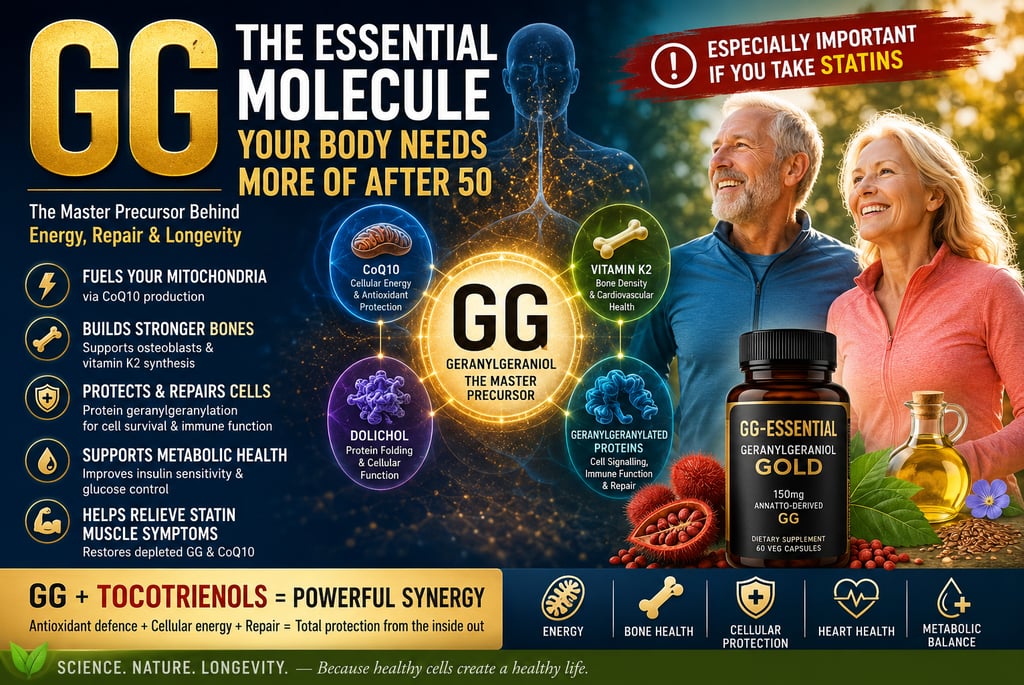
GG sits at a critical junction in this pathway. It is the essential precursor from which the body builds:
Coenzyme Q10 (CoQ10) - the molecule that powers every mitochondrion in every cell in your body, and a critical antioxidant in its own right
Vitamin K2 - essential for calcium metabolism, bone density and cardiovascular health
Dolichol - required for proper protein folding and glycoprotein synthesis inside cells
Geranylgeranylated proteins - a class of signalling proteins critical for cell survival, immune function, and cellular repair
Without adequate GG, the production of all of these downstream molecules is compromised. It is a single chokepoint with cascading consequences throughout the body.
The Statin Problem - Why Millions of Australians May Be GG-Deficient
Here is where GG becomes urgently relevant for a very large proportion of the population.
Statin drugs, prescribed to lower LDL cholesterol and reduce cardiovascular risk, are among the most widely prescribed medications in Australia. They work by blocking HMG-CoA reductase, a key enzyme in the mevalonate pathway.
The problem is that blocking this pathway doesn't just lower cholesterol. It also blocks the production of GG and CoQ10 simultaneously. The body cannot distinguish between "lower cholesterol" and "also stop making GG and CoQ10", the blockade is non-selective.
This is the mechanism behind one of the most common and distressing statin side effects: statin-associated muscle symptoms (SAMS), the muscle pain, weakness, and fatigue that cause many patients to discontinue their medication. Muscle cells are among the most metabolically demanding in the body; without CoQ10 and GG to fuel their mitochondria and maintain cell membrane integrity, muscle cells begin to malfunction and, in severe cases, break down.
A 2023 peer-reviewed paper published in Frontiers in Physiology confirmed that GG supplementation shows significant promise in managing statin-associated muscle symptoms by restoring depleted precursor levels, with the researchers noting that GG depletion, rather than CoQ10 depletion alone, may be the primary driver of SAMS. This is an important finding because standard CoQ10 supplementation, widely recommended for statin users, may not be sufficient if the underlying GG deficiency is not also addressed.
If you are currently taking a statin, this research is directly relevant to you.
GG and the Mitochondria: Your Cellular Power Stations
Every cell in your body contains mitochondria, tiny structures that generate ATP, the energy currency of life. Mitochondria are also the primary site of free radical (ROS) production in the body, making them simultaneously your most important energy generators and your greatest source of oxidative stress.
GG supports mitochondrial health through its role as CoQ10 precursor, CoQ10 is embedded in the inner mitochondrial membrane where it performs two essential jobs: shuttling electrons during energy production, and acting as a potent antioxidant that neutralises the ROS generated by that same process. Without adequate GG to maintain CoQ10 synthesis, mitochondria become both less efficient at generating energy and more vulnerable to oxidative self-destruction, a combination that accelerates cellular ageing throughout the entire body.
GG and Bone Health - A Critical Link That Most People Don't Know About
Osteoporosis affects approximately one in three Australian women and one in five men over 50, yet the role of GG in bone health is almost entirely unknown outside specialist research circles.
GG supports bone health through direct actions on the cells that build and break down bone:
Promotes osteoblast differentiation and activity - osteoblasts are the bone-building cells, GG stimulates their development and function
Inhibits excessive osteoclast activity - osteoclasts break down bone; in osteoporosis, osteoclast activity outpaces osteoblast repair, GG helps restore this balance
Counteracts statin-induced bone loss - statin drugs impair the mevalonate pathway and with it the GG production that osteoblasts depend on, contributing to accelerated bone loss in long-term statin users
Supports vitamin K2 synthesis - vitamin K2 is essential for directing calcium into bones rather than arteries; GG is required for its production
A 2023 study published in a peer-reviewed journal examined GG's direct application in human osteoblasts and osteoclasts, confirming its anabolic (bone-building) effects at the cellular level. Separate research found that dietary GG supplementation protected against bone loss associated with mevalonate pathway disruption, directly relevant to both statin users and postmenopausal women.
GG and Metabolic Health - Glucose, Insulin and Diabetes Risk
Emerging research is pointing to GG as a significant player in metabolic health, the domain of blood sugar regulation, insulin sensitivity, and the prevention of type 2 diabetes.
A 2021 study published in Nutrition Research found that dietary GG supplementation significantly improved glucose homeostasis and insulin sensitivity in subjects on a high-fat diet. The researchers identified multiple mechanisms: GG supports the geranylgeranylation of proteins involved in insulin signalling, improves cellular energy metabolism via CoQ10, and reduces the mitochondrial dysfunction that drives insulin resistance.
This is particularly meaningful given the well-established link between oxidative stress and type 2 diabetes, GG addresses both the metabolic dysfunction and the underlying oxidative damage simultaneously.
GG and Cellular Repair - The Protein Geranylgeranylation Connection
Beyond its role as a CoQ10 precursor, GG performs a second critical function at the cellular level: it is required for a process called protein geranylgeranylation, the attachment of GG molecules to small signalling proteins (Rho, Rac, and Rap families) that regulate cell survival, immune function, cytoskeletal organisation, and cellular repair.
These proteins must be geranylgeranylated, physically modified with a GG molecule, to attach to cell membranes and carry out their functions. Without adequate GG, these proteins remain inactive in the cytoplasm, impairing cell-to-cell communication, immune surveillance, and the repair of oxidatively damaged tissue.
This mechanism connects GG depletion directly to the accelerated cellular ageing and impaired repair capacity that characterises many age-related diseases, including the neurodegenerative conditions that are increasingly understood as diseases of failed cellular maintenance.
GG and Tocotrienols - Better Together
GG and tocotrienols are not merely individually beneficial, they are synergistic partners derived from the same annatto plant, operating through complementary and overlapping pathways.
Where tocotrienols excel at directly neutralising free radicals, suppressing NF-κB inflammation and inducing cancer cell apoptosis, GG excels at maintaining the cellular energy infrastructure, repair machinery, and bone metabolism that underpin long-term health.
Together, they provide a comprehensive, multi-layered defence against the oxidative and cellular-energy challenges that drive chronic disease:
T3 and GG - A Powerful Partnership
What Tocotrienols (T3) Do Best:
Neutralise free radicals directly in cell membranes
Suppress the NF-κB inflammatory cascade
Protect brain neurons from oxidative death
Induce cancer cell apoptosis (programmed cell death)
Reduce cardiovascular oxidative damage
Preserve telomere length, slowing cellular ageing
What Geranylgeraniol (GG) Does Best:
Fuel mitochondria via CoQ10 production
Activate cellular repair and survival signalling proteins
Rebuild bone by supporting osteoblast (bone-building) cells
Restore GG and CoQ10 depleted by statin medications
Support insulin sensitivity and glucose control
Enable vitamin K2 and dolichol synthesis
Together, T3 and GG form a scientifically validated partnership, one providing powerful antioxidant and anti-inflammatory defence, the other maintaining the cellular energy, repair and bone-building infrastructure that chronic oxidative stress systematically destroys. Research on the combination shows improved lipid profiles, reduced oxidative markers, and complementary action across cardiovascular, neurological, metabolic and musculoskeletal health.
A 2020 peer-reviewed study directly examined the combination of GG and tocotrienols in metabolic dysfunction, finding improved lipid profiles and reduced oxidative markers in the combined treatment group, confirming the synergistic potential. Dr Barrie Tan, who pioneered the research on both compounds and their extraction from annatto, describes them as complementary molecules that together address the full spectrum of oxidative and cellular-energy challenges underlying modern chronic disease.
Who Needs GG Most?
While GG is beneficial across all adult age groups, the need is most acute in certain populations:
Adults over 50 - endogenous GG production declines with age
Statin users - statins directly deplete GG and CoQ10 via mevalonate pathway blockade
Postmenopausal women - oestrogen decline impairs mevalonate pathway function, reducing GG-dependent bone protection
People with chronic fatigue - mitochondrial dysfunction from GG/CoQ10 depletion is a key driver
Anyone with muscle weakness or pain - especially if taking statins
People with metabolic syndrome or insulin resistance - GG supports the cellular energy and signalling pathways disrupted in these conditions
The Bottom Line
GG is not a trendy supplement or a wellness fad. It is a fundamental cellular building block, one that the body makes less of as we age, and less still if we take some of the most common medications in modern medicine.
Restoring adequate GG levels, alongside the potent antioxidant protection of annatto tocotrienols, addresses the root causes of cellular dysfunction rather than simply managing symptoms. The science is compelling, the safety profile is excellent, and the need, particularly for Australians over 50, is real.
Natural Health Connect stocks GG-Essential (Geranylgeraniol Gold), 150mg annatto-derived GG capsules, alongside our premium Eannatto Tocotrienol range. Visit www,naturalhealthconnect.com.au to learn more or contact our team for personalised guidance.
This article is for educational purposes and does not constitute medical advice. Please consult your healthcare practitioner before commencing any new supplement regimen, particularly if you are currently taking statin medications.