
Understanding Oxidative Stress and Chronic Disease
Explore the hidden threat of oxidative stress, its impact on chronic diseases like heart disease and cancer, and discover how tocotrienols can help combat this health risk. Learn why oxidative stress is a growing concern for Australians and how to protect your health.
ANTI-AGEINGCANCERCARDIOVASCULAR HEALTHIMMUNE SYSTEMGERANYLGERANIOL (GG)CANCER PREVENTIONMETABOLIC HEALTHBRAIN HEALTHINFLAMMATIONCELLULAR HEALTHBONE HEALTHANNATTO TOCOTRIENOLLONGEVITYTYPE 2 DIABETESCANCERPREVENTIONMUSCLE HEALTH
Natural Health Connect Research
5/22/202611 min read
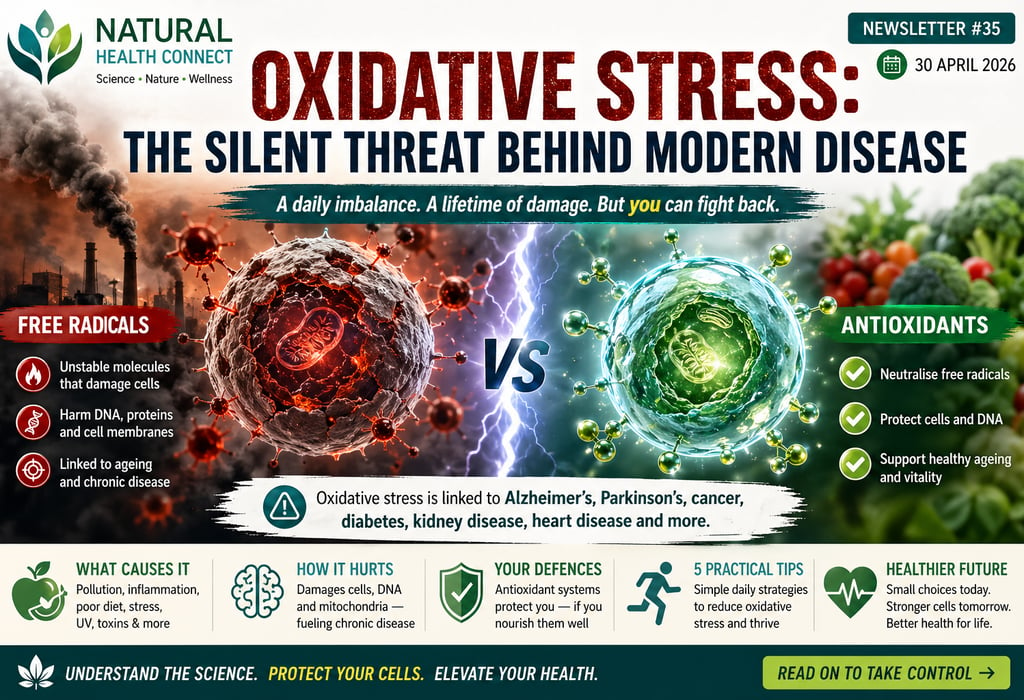
What Is Oxidative Stress? A Plain-Language Explanation
Your body runs on oxygen. Every cell generates energy by burning fuel with oxygen, essentially a controlled combustion process occurring trillions of times per second. But this combustion is imperfect. As a natural byproduct, it produces highly reactive, unstable molecules called free radicals and reactive oxygen species (ROS).
Think of free radicals as tiny, hyperactive sparks. Each one is missing an electron, which makes it chemically desperate, it will violently "steal" an electron from the nearest stable molecule it can find. When a free radical steals an electron from a healthy cell component, a membrane, a protein, a strand of DNA, it damages that component and critically, turns it into a new free radical, which then attacks its neighbour. This is the chain reaction of oxidative damage.
Your body has a natural defence system, antioxidants, specifically designed to intercept free radicals and neutralise them before they cause harm. Under normal conditions, there is a healthy balance between free radical production and antioxidant defences.
Oxidative stress occurs when this balance breaks down, when free radical production overwhelms the body's ability to neutralise them. The excess radicals run rampant, attacking cell membranes (lipid peroxidation), disabling proteins and enzymes, and fragmenting DNA. The result is cumulative, compounding cellular damage, the biological equivalent of that invisible internal fire.
Why Modern Life Is an Oxidative Stress Factory
Our ancestors' bodies evolved to handle a certain level of free radical exposure. What they never evolved to cope with is the extraordinary oxidative load of 21st-century life.
Every one of the following common modern-day factors ramps up free radical production:
Ultra-processed food and sugar - inflammatory dietary patterns increase ROS production and impair antioxidant enzymes
Chronic psychological stress - stress hormones like cortisol trigger inflammatory cascades that generate free radicals
Air pollution - fine particulate matter (PM2.5) directly generates ROS in lung and cardiovascular tissue
Alcohol consumption - alcohol metabolism produces large quantities of reactive oxygen species in the liver
Cigarette smoke - contains billions of free radicals per puff and depletes antioxidant reserves
Pesticides and environmental toxins - disrupt mitochondrial function and trigger oxidative bursts
Sleep deprivation - impairs the body's overnight antioxidant repair processes
Sedentary lifestyle - paradoxically, both excessive inactivity and extreme over-exercise can elevate oxidative stress
Ageing itself - mitochondrial efficiency declines with age, producing more ROS with less energy output
The cumulative effect is that most adults over 50 are living in a state of chronic, low-grade oxidative stress without knowing it. There are no obvious symptoms in the early stages. By the time disease manifests, the damage has been accumulating silently for years.
The Diseases Driven by Oxidative Stress
Oxidative stress is not simply one factor among many in chronic disease, for many conditions, it is the upstream driver. Here is what the science shows:
Heart Disease and Atherosclerosis
Oxidative stress is central to the development of atherosclerosis, the dangerous hardening and narrowing of arteries that causes heart attacks and strokes. When LDL cholesterol is oxidised by free radicals, it becomes far more inflammatory and toxic to artery walls, triggering the formation of plaques. Free radicals also damage the endothelium (the arterial lining), impairing its ability to regulate blood pressure and blood flow. Heart disease kills more Australians than any other single condition.
Alzheimer's Disease and Dementia
The brain is uniquely vulnerable to oxidative damage, it consumes 20% of the body's oxygen despite being only 2% of body weight, yet has comparatively limited antioxidant defences. Oxidative stress drives the formation of amyloid plaques and tau tangles, the two hallmarks of Alzheimer's disease, and causes widespread neuronal death through a process called oxidative neurodegeneration. Dementia is the second-leading cause of death in Australia and the single leading cause of death among women.
Cancer
Cancer development involves three key stages, initiation, promotion, and progression and oxidative stress plays a role in all three. Free radicals directly damage DNA, causing the mutations that can initiate cancerous transformation. ROS also activate oncogenic signalling pathways (including NF-κB, a key inflammatory switch), suppress tumour-suppressor genes and promote the tumour microenvironment that allows cancer cells to evade immune destruction.
Type 2 Diabetes
Oxidative stress impairs insulin signalling and damages the beta cells of the pancreas that produce insulin. It also worsens insulin resistance by disrupting glucose transport into cells. The resulting hyperglycaemia then generates yet more free radicals, creating a vicious cycle that accelerates diabetic complications including neuropathy, nephropathy, and retinopathy.
Parkinson's Disease
The dopamine-producing neurons of the substantia nigra, the cells destroyed in Parkinson's disease, are exceptionally vulnerable to oxidative stress due to the oxidative chemistry of dopamine metabolism itself. Oxidative damage to mitochondria in these cells triggers the neuronal death cascade that defines the disease.
Osteoporosis and Musculoskeletal Decline
Oxidative stress promotes osteoclast activity (bone breakdown) while suppressing osteoblast function (bone building), shifting the balance toward bone loss. It also damages muscle cell membranes and mitochondria, contributing to the age-related muscle loss known as sarcopenia.
Enter Tocotrienols - The Superior Vitamin E That Most People Have Never Heard Of
Most people have heard of Vitamin E. What most people don't know is that "Vitamin E" is not a single compound, it is a family of eight related molecules: four tocopherols and four tocotrienols (alpha, beta, gamma, and delta forms of each).
For decades, almost all Vitamin E research and supplementation focused exclusively on alpha-tocopherol, the form most abundant in the Western diet. Meanwhile, the tocotrienol forms were largely ignored. This turned out to be a profound oversight.
Why Tocotrienols Outperform Tocopherols
Tocotrienols differ from tocopherols in one critical structural feature: their molecular tail. Tocopherols have a saturated (rigid) phytyl tail, while tocotrienols have an unsaturated (flexible) farnesyl tail with three double bonds. This structural difference has enormous biological consequences:
50–60 times more powerful as antioxidants than alpha-tocopherol in cell membranes, the flexible tail allows tocotrienols to move rapidly and uniformly through the membrane bilayer, covering far more territory per molecule
Deeper membrane penetration - tocotrienols insert themselves more efficiently into cell membranes, where lipid peroxidation chain reactions begin
Unique signalling capabilities - tocotrienols modulate gene expression pathways (including NF-κB, the master inflammatory switch) in ways that tocopherols cannot
Anti-tumour activity - tocotrienols trigger apoptosis (programmed death) in cancer cells through mechanisms entirely absent from tocopherols
A 2024 systematic review directly comparing tocotrienols and tocopherols confirmed the superior efficacy of tocotrienols in cardiovascular outcomes, finding meaningful reductions in total cholesterol, LDL-cholesterol, triglycerides, and inflammatory markers that tocopherols failed to match.
Why Annatto Is the Gold Standard Source
Tocotrienols are found in small quantities in palm oil, rice bran, and wheat germ. But the annatto plant (Bixa orellana) is uniquely special: it is the only plant source in the world that produces tocotrienols with no tocopherols whatsoever, delivering exclusively the most bioactive delta (δ) and gamma (γ) forms.
This matters enormously. Research by Dr Barrie Tan, the world's foremost tocotrienol scientist, has demonstrated that the presence of alpha-tocopherol actually interferes with tocotrienol absorption and function, competing for the same cellular receptors and reducing efficacy by up to 50%. Annatto-derived tocotrienols sidestep this problem entirely, delivering pure, uncompetitive delta and gamma tocotrienols, the forms with the strongest antioxidant, anti-cancer and cardioprotective activity.
What Tocotrienols Do in the Body: The Evidence
1. Cardiovascular Protection
Annatto tocotrienols have demonstrated significant cardiovascular benefits across multiple clinical studies. A landmark clinical trial found that participants supplementing with annatto tocotrienols experienced significant reductions in LDL-cholesterol and triglycerides alongside improved antioxidant status. A 2025 randomised controlled trial confirmed that tocotrienol supplementation reduced key cardiovascular risk markers, including oxidised LDL, a direct measure of free radical damage to cholesterol, in at-risk adults.
Tocotrienols protect the cardiovascular system through multiple simultaneous mechanisms: reducing oxidative modification of LDL cholesterol, suppressing arterial inflammation via NF-κB inhibition, improving endothelial function, and modulating HMG-CoA reductase (the same enzyme targeted by statin drugs) to reduce harmful cholesterol production.
2. Brain Protection and Dementia Prevention
Tocotrienols are among the most potent neuroprotective compounds identified in nutritional science. Delta and gamma tocotrienols specifically target oxidative-stress-induced neurodegeneration by:
Protecting neuronal cell membranes from lipid peroxidation
Suppressing glutamate-induced excitotoxicity (a key driver of neuron death)
Modulating NF-κB to reduce neuroinflammation, a critical upstream factor in both Alzheimer's and Parkinson's disease
Preserving telomere integrity in neurons, a 2009 study showed gamma-tocotrienol prevented oxidative-stress-induced telomere shortening, effectively slowing a key biological ageing mechanism in neural tissue
A 2025 RCT published by researchers at Monash University, whose research group includes Prof Andrew Sinclair, demonstrated that tocotrienol supplementation reduced oxidative stress markers in older adults, supporting the cognitive health applications.
3. Anti-Cancer Activity
Tocotrienols, particularly the delta form abundant in annatto, have demonstrated remarkable anti-cancer properties across over 60 peer-reviewed studies. Unlike tocopherols, tocotrienols can:
Suppress the NF-κB pathway, which cancer cells use to resist apoptosis and drive tumour growth
Induce apoptosis (programmed cell death) selectively in cancer cells while leaving healthy cells intact
Inhibit angiogenesis, the formation of new blood vessels that tumours require to grow
Act synergistically with conventional chemotherapy, potentially allowing lower doses and reduced side effects
Target cancer stem cells, which are responsible for treatment resistance and tumour recurrence
Delta-tocotrienol has shown particularly potent activity against pancreatic, breast, colorectal, and prostate cancers in preclinical and early clinical research.
4. Anti-Inflammatory and Antioxidant Cascade
At the molecular level, tocotrienols are master regulators of the oxidative-inflammatory cycle. They neutralise free radicals directly, but more importantly, they switch off the NF-κB pathway, the inflammatory master switch that, when chronically activated by oxidative stress, drives the sustained inflammation underlying virtually every chronic disease. A 2025 review from Monash University researchers confirmed that tocotrienol's modulation of NF-κB signalling represents a key therapeutic mechanism in neurodegenerative disease.
Geranylgeraniol (GG) - The Essential Co-Factor the Body Can't Afford to Lose
While tocotrienols have received growing scientific attention, geranylgeraniol (GG) remains even less known, yet may be equally important to cellular health, particularly as we age.
GG is a natural diterpenoid compound found in small amounts in annatto, flaxseed, olive oil and several herbs. It is also synthesised endogenously within the body via the mevalonate pathway, the same biochemical pathway that produces cholesterol, CoQ10, and other critical molecules.
What makes GG remarkable is its role as a master precursor molecule, it is the essential building block for several compounds the body absolutely requires for cellular energy, protection, and repair.
GG and CoQ10 - The Mitochondrial Connection
Coenzyme Q10 (CoQ10) is indispensable for mitochondrial energy production and is itself a potent antioxidant, protecting the mitochondrial membrane, the cellular site of highest free radical generation, from oxidative damage. GG is a direct precursor in the biosynthesis of CoQ10.
This is why the GG-CoQ10 connection has become a critical clinical issue: statin drugs, among the most widely prescribed medications in Australia, block the mevalonate pathway to lower cholesterol, but in doing so they deplete both CoQ10 and GG simultaneously. The well-known statin side effect of muscle pain and weakness (myopathy) is now understood to result largely from this depletion of GG and CoQ10, depriving muscle cells of the energy and antioxidant protection they need to function. A 2023 peer-reviewed paper in Frontiers in Physiology confirmed that GG supplementation shows significant promise in managing statin-associated muscle symptoms by restoring depleted precursor levels.
GG and Cellular Repair
GG is essential for a process called protein geranylgeranylation, the attachment of GG molecules to signalling proteins that regulate cell survival, immune function, and cellular repair. Without adequate GG, these proteins cannot anchor to cell membranes and perform their functions. This is particularly relevant in the context of oxidative stress, where cellular repair mechanisms must work overtime to reverse damage.
GG and Bone Health
GG directly supports bone health by promoting osteoblast (bone-building cell) differentiation and function, while simultaneously inhibiting the excessive osteoclast activity that drives osteoporosis. Research has shown that GG supplementation can counteract the bone loss associated with statin use and with postmenopausal oestrogen decline, both of which impair the mevalonate pathway that GG replenishes.
GG and Metabolic Health
A 2021 animal study published in a peer-reviewed nutrition journal found that dietary GG supplementation significantly improved glucose homeostasis and insulin sensitivity in subjects on a high-fat diet, pointing to potential therapeutic applications in type 2 diabetes and metabolic syndrome. GG also supports the production of dolichol, a molecule required for proper protein folding in cells and vitamin K2, which is critical for calcium metabolism and cardiovascular health.
The T3 + GG Combination - A Synergistic Power Duo
What is particularly compelling is that tocotrienols and GG are not merely individually beneficial, they work together synergistically in ways that amplify each other's effects.
Both compounds are derived from the same annatto plant. Both operate within overlapping cellular pathways. Together, they provide a comprehensive cellular defence strategy:
How T3 and GG Work Together - Complementary Strengths
Tocotrienols (T3) excel at:
Direct free radical neutralisation — extremely potent
Protecting cell membranes from lipid peroxidation
Suppressing NF-κB, the body's master inflammatory switch
Triggering programmed death in cancer cells (apoptosis)
Reducing cardiovascular oxidative damage
Protecting brain neurons from oxidative death
Geranylgeraniol (GG) excels at:
Fuelling mitochondria via direct CoQ10 production
Activating cellular repair and signalling proteins
Rebuilding bone via osteoblast (bone-building cell) support
Restoring GG and CoQ10 depleted by statin medications
Supporting insulin sensitivity and glucose metabolism
Enabling vitamin K2 and dolichol synthesis
Together, T3 and GG provide a comprehensive, multi-layered cellular defence, one targeting the oxidative fire directly, the other rebuilding the energy and repair systems that oxidative damage destroys.
A 2020 study directly examined the combination of GG and tocotrienols in the context of high-fat diet-induced metabolic dysfunction, finding improved lipid profiles and reduced oxidative markers in the combined treatment group. Dr Barrie Tan, who has spent over 30 years researching both compounds and pioneered their extraction from annatto, describes them as complementary molecules that together address the full spectrum of oxidative and cellular-energy challenges that underlie modern chronic disease.
Prevention vs Treatment - Two Roles, One Strategy
A crucial distinction is worth making: tocotrienols and GG have demonstrated value both as preventive agents and as therapeutic supports for established disease, a combination that is rare in nutritional science.
For Prevention:
Research consistently shows that maintaining optimal levels of tocotrienols and GG from middle age onwards, before disease develops, provides the most robust protection against oxidative damage accumulation. Like maintaining a fire-suppression system before a fire starts, the antioxidant and anti-inflammatory mechanisms of T3 and GG work best when deployed early.
For Treatment Support:
For those already living with cardiovascular disease, early cognitive decline, metabolic syndrome, or taking statins, the evidence supports T3 and GG as valuable adjuncts to conventional therapy. Tocotrienols have been shown to work synergistically with certain chemotherapy agents in cancer; GG has shown the ability to restore muscle function in statin users; and both compounds address the oxidative and inflammatory drivers that conventional medications often leave unaddressed.
A 2026 New Study - The Ageing Connection
A compelling new human study published in April 2026 found that Vitamin E supplementation — specifically tocotrienol-based — may reduce measurable signs of biological ageing, reinforcing the anti-ageing potential of these compounds beyond disease prevention alone. This aligns with earlier research showing tocotrienols prevent oxidative-stress-induced telomere shortening, one of the most significant known drivers of cellular ageing, in human cell models.
As science continues to build the case that biological ageing is substantially driven by accumulated oxidative damage, the role of potent, bioavailable antioxidants like tocotrienols becomes ever more central.
What You Can Do Starting Today
Combating oxidative stress requires a multi-pronged approach. Lifestyle is the foundation:
Eat a wholefoods diet rich in colourful vegetables and fruits - natural sources of antioxidant vitamins, polyphenols, and minerals
Minimise ultra-processed foods, refined sugar, and alcohol - major drivers of oxidative load
Move daily - moderate, consistent exercise trains the body's own antioxidant enzyme systems
Prioritise sleep - the body's primary oxidative repair window occurs during deep sleep
Reduce chronic stress - through mindfulness, breathing practices, time in nature, or social connection
Limit exposure to environmental toxins - choose organic where practical, filter drinking water, minimise plastics
However, even an excellent lifestyle cannot fully compensate for the oxidative challenges of modern life, particularly past middle age, when the body's own antioxidant capacity naturally declines. This is where targeted supplementation with clinically researched compounds like annatto-derived tocotrienols and geranylgeraniol provides a meaningful, evidence-based layer of additional protection.
The Bottom Line
Oxidative stress is not a niche scientific concept, it is the invisible thread connecting the most devastating chronic diseases of our time. The good news is that we now have a growing body of rigorous scientific evidence pointing to natural, well-tolerated compounds that can meaningfully counteract it.
Tocotrienols, particularly the delta and gamma forms from annatto, are the most potent, biologically active forms of Vitamin E ever identified, with documented benefits across cardiovascular health, brain health, cancer prevention, and systemic inflammation. Geranylgeraniol is the essential cellular precursor that keeps the body's energy production, repair machinery, and bone metabolism functioning optimally, particularly critical for anyone over 50 or taking statin medications.
Together, T3 and GG represent a scientifically grounded, synergistic approach to addressing the root cause of most chronic disease, not just masking symptoms, but actually targeting the oxidative fire at its source.
Natural Health Connect stocks premium annatto-derived tocotrienols and GG-Essential (Geranylgeraniol), the same compounds referenced throughout this article. Visit naturalhealthconnect.com.au to learn more or speak to our team about which products are right for you.
This article is for educational purposes and does not constitute medical advice. Please consult your healthcare practitioner before commencing any new supplement regimen.
References and Further Reading: All scientific claims in this article are supported by peer-reviewed research published in journals including Frontiers in Nutrition, Frontiers in Physiology, PLOS ONE, PubMed Central / NIH, and the American Journal of Clinical Nutrition, among others. A full reference list is available on request.