
Rethinking Dementia - A Unified Approach
Discover how our research redefines dementia and Alzheimer's disease through a unified model of neurodegeneration. Learn about interconnected failure loops and how they can lead to earlier and more effective interventions to delay or prevent cognitive decline.
GERANYLGERANIOL (GG)ANNATTO TOCOTRIENOLBRAIN HEALTHCELLULAR HEALTH
Natural Health Connect Research
3/31/20267 min read
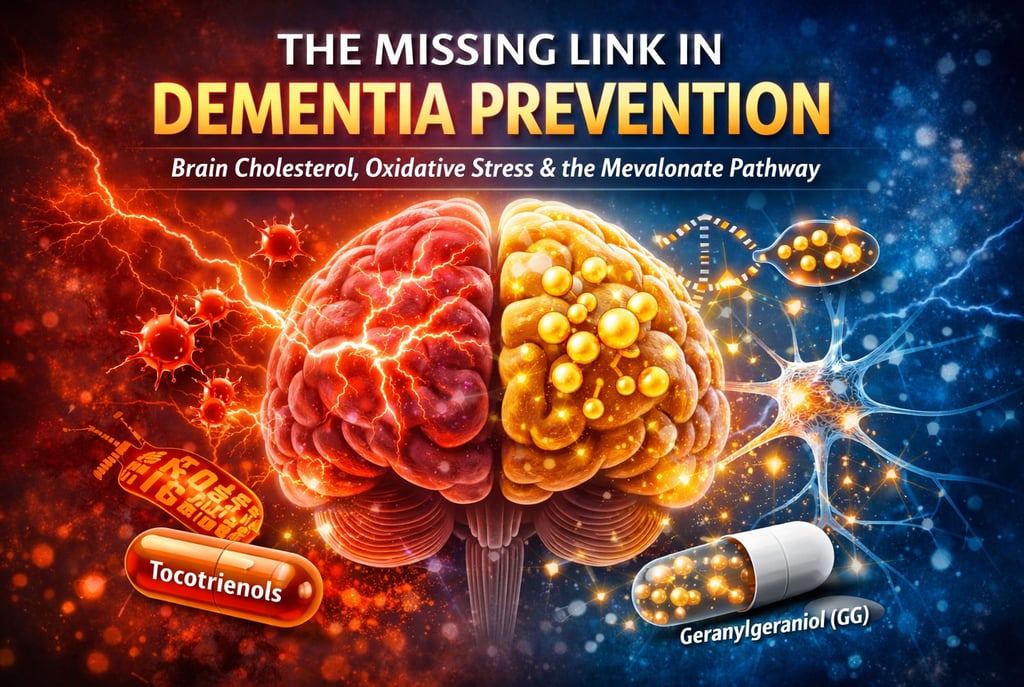
🧠 The Brain Runs on Cholesterol But Not the Way You Think
The brain contains ~25% of the body’s total cholesterol, despite being only 2% of body weight.
But here’s the critical point:
👉 Brain cholesterol is made locally
👉 It cannot cross the blood–brain barrier
This cholesterol is essential for:
Myelin formation (insulating nerve fibres)
Synaptic signalling (memory and learning)
Neurotransmitter receptor function
Structural integrity of neurons
Without it, the brain simply cannot function properly.
⚠️ When Cholesterol Becomes Toxic - The Oxidative Trap
Cholesterol itself is not the enemy.
The problem begins when it is attacked by reactive oxygen species (ROS).
This creates toxic compounds called oxysterols, especially:
7-ketocholesterol (7KC)
7β-hydroxycholesterol (7βHC)
These drive a destructive cascade:
🔥 Excess ROS production (vicious cycle)
🧬 Mitochondrial damage
🧪 Neuroinflammation
💀 Neuronal death
This is one of the primary engines of neurodegeneration.
🔬 The Missing Piece - The Brain’s Mevalonate Pathway
This is where our work becomes truly groundbreaking.
Most people think the mevalonate pathway exists mainly to produce cholesterol.
But in the brain:
👉 Its most critical outputs are isoprenoids, not cholesterol.
Specifically:
Farnesyl pyrophosphate (FPP)
Geranylgeranyl pyrophosphate (GGPP)
These molecules enable protein prenylation, a process essential for:
Synaptic vesicle release (memory signalling)
Dendritic spine formation (learning)
Axonal transport (cellular logistics)
Mitochondrial function (energy)
Without GGPP:
Neurons lose their ability to communicate, adapt, and survive.
⚠️ A Critical Insight: It’s Not Just Deficiency - It’s Dysregulation
One of the most important findings:
In ageing and statin use → GGPP can be depleted
In Alzheimer’s → GGPP can be elevated but dysregulated
This creates two dangerous states:
1. Too Little (Depletion)
Synaptic failure
Impaired memory
Neuronal death
2. Too Much (Dysregulated)
Increased amyloid production
Tau pathology
Neuroinflammation
👉 The real goal is balance, not suppression
💊 The Statin Question - An Under-Recognised Risk
Our analysis highlights a major clinical concern:
Lipophilic statins (e.g. simvastatin, atorvastatin):
Cross the blood–brain barrier
Reduce GGPP more than cholesterol
Impair synaptic function
In animal models:
GGPP ↓ 33%
FPP ↓ 52%
Cholesterol ↓ only 22%
This disproportionate depletion directly affects:
Memory
Synaptic plasticity
Neuronal surviva
🌿 A New Strategy - PREVENT + RESTORE
Our work identifies a dual-intervention model that addresses the entire cascade:
🛡️ 1. Annatto Tocotrienols (T3) - PREVENT
Key actions:
40–60× more potent antioxidant than alpha-tocopherol
Prevents formation of toxic oxysterols (7KC, 7βHC)
Modulates (not blocks) the mevalonate pathway
Reduces neuroinflammation (NF-κB)
Enhances synaptic signalling
👉 Stops damage at the source
🔧 2. Geranylgeraniol (GG) - RESTORE
Key actions:
Direct precursor to GGPP
Restores protein prenylation
Reverses synaptic dysfunction
Supports mitochondrial function via CoQ10
Rescues statin-induced neuronal damage
👉 Rebuilds what the brain has lost
🔗 Why the Combination Matters
This is the breakthrough:
T3 protects the system. GG restores the system.
Together they:
Prevent oxidative damage
Restore synaptic communication
Stabilise mitochondrial function
Reduce inflammation
Support myelin repair
No previous intervention has addressed all of these simultaneously.
🧠 The Three Stages of Cognitive Decline (A Practical Model)
Stage 1. Pre-MCI (Silent Phase)
Early oxidative stress
Declining GG and CoQ10
Subtle synaptic inefficiency
Stage 2. Mild Cognitive Impairment (MCI)
Impaired neurotransmission
Memory lapses
Rising toxic oxysterols
Stage 3. Dementia
Amyloid and tau pathology
Mitochondrial collapse
Neuronal loss
👉 The intervention window is Stage 1–2
This is where prevention is still possible.
📊 Human Evidence Supporting This Model
Our research highlights key clinical findings:
Higher tocotrienol levels → lower Alzheimer’s risk
Tocotrienols slowed white matter lesion progression (2-year RCT)
Improved memory and reduced inflammation in clinical trials
And critically:
Antioxidant depletion is already present in MCI, not just dementia.
🚨 Why This Matters Now
Dementia rates are rising globally.
But this research suggests:
👉 It is not inevitable
👉 It is biochemically driven
👉 It is potentially modifiable
And most importantly:
We now understand the system well enough to intervene intelligently.
✅ Key Takeaways
Brain health depends on cholesterol AND isoprenoid balance
Oxidative stress converts cholesterol into neurotoxic compounds
GGPP is essential for memory, synapses, and neuron survival
Ageing, statins, and disease disrupt this system
A dual strategy of:
Tocotrienols (protect)
Geranylgeraniol (restore)
offers a complete mechanistic solution
🔬 Final Word
This is more than a theory.
It is a fully integrated biological model of neurodegeneration, one that:
Explains previous contradictions
Identifies precise intervention points
Opens the door to true prevention strategies
The upcoming BRAIN-GUARD Trial is the next critical step.
📩 Want to Stay Informed?
Subscribe to Natural Health Connect for ongoing updates on:
Dementia prevention strategies
Clinical trial developments
Evidence-based nutritional interventions
References
Foundational Neuroscience - Mevalonate Pathway and Isoprenoids in the Brain
Kotti TJ, Ramirez DMO, Pfeiffer BE, Huber KM, Russell DW (2006). Brain cholesterol turnover required for geranylgeraniol production and learning in mice. Proc Natl Acad Sci USA, 103(10):3869–74. https://www.pnas.org/doi/10.1073/pnas.0600316103
Eckert GP, Hooff GP, Strandjord DM, Igbavboa U, Volmer DA, Müller WE, Wood WG (2009). Regulation of the brain isoprenoids farnesyl- and geranylgeranylpyrophosphate is altered in male Alzheimer patients. Neurobiol Dis, 35(2):251–7. https://pmc.ncbi.nlm.nih.gov/articles/PMC3778879/
Hooff GP, Wood WG, Müller WE, Eckert GP (2010). Isoprenoids, small GTPases and Alzheimer's disease. Biochim Biophys Acta, 1801(8):896–905. https://pmc.ncbi.nlm.nih.gov/articles/PMC2886181/
Kotti TJ, McDonald DL, Stevenson DE, Kotti A, Sheroni NN, Ramirez DMO, Russell DW (2008). Biphasic requirement for geranylgeraniol in hippocampal long-term potentiation. Proc Natl Acad Sci USA, 105(32):11394–9. https://www.pnas.org/doi/10.1073/pnas.0805556105
Hoof, G.P., Wood WG, Igbavboa U, Eckert GP, Müller WE (2012). Brain isoprenoids farnesyl pyrophosphate and geranylgeranyl pyrophosphate are increased in aged mice. Neurobiol Aging, 33(9):2031–2040. https://pubmed.ncbi.nlm.nih.gov/22692983/
Schulz JG, Bösel J, Stoeckel M, Megow D, Dirnagl U, Endres M (2004). HMG-CoA reductase inhibition causes neurite loss by interfering with geranylgeranylpyrophosphate synthesis. J Neurochem, 89(1):24–32. https://pubmed.ncbi.nlm.nih.gov/15030386/
Protein Prenylation and GTPase Signalling in Neurons
Afshordel S, Wood WG, Igbavboa U, Muller WE, Eckert GP (2014). Impaired geranylgeranyltransferase-I regulation reduces membrane-associated Rho protein levels in aged mouse brain. J Neurochem, 129(4):732–42. https://pmc.ncbi.nlm.nih.gov/articles/PMC3999261/
Hooff GP, Wood WG, Müller WE, Eckert GP (2010). Isoprenoids, small GTPases and Alzheimer's disease (full review). https://pmc.ncbi.nlm.nih.gov/articles/PMC2886181/
Cholesterol Oxidation and Oxysterols
Cutler RG, Kelly J, Storie K, Pedersen WA, Tammara A, Hatanpaa K, Troncoso JC, Mattson MP (2004). Involvement of oxidative stress-induced abnormalities in ceramide and cholesterol metabolism in brain aging and Alzheimer's disease. Proc Natl Acad Sci USA, 101(7):2070–5. https://pmc.ncbi.nlm.nih.gov/articles/PMC357053/
McComb M, Browne RW, Bhattacharya S, Bodziak ML, Jakimovski D, Weinstock-Guttman B, Kuhle J, Zivadinov R, Ramanathan M (2021). The cholesterol autoxidation products, 7-ketocholesterol and 7β-hydroxycholesterol are associated with serum neurofilaments in multiple sclerosis. Mult Scler Relat Disord, 50:102864. https://pubmed.ncbi.nlm.nih.gov/33677412/
Oxysterol signalling in the central nervous system (2026, review). Front Mol Neurosci. https://www.frontiersin.org/journals/molecular-neuroscience/articles/10.3389/fnmol.2026.1709065/full
GGPP Stimulation of γ-Secretase and Amyloid Pathology
Zhou Y, Suram A, Venugopal C, Prakasam A, Lin S, Su Y, Li B, Paul SM, Sambamurti K (2008). Geranylgeranyl pyrophosphate stimulates gamma-secretase to increase the generation of Aβ and APP-CTFγ. FASEB J, 22(1):47–54. https://pmc.ncbi.nlm.nih.gov/articles/PMC2859886/
Statins and the Blood-Brain Barrier
Saheki A, Terasaki T, Tamai I, Tsuji A (1994). In vivo and in vitro blood-brain barrier transport of 3-hydroxy-3-methylglutaryl coenzyme A (HMG-CoA) reductase inhibitors. Pharm Res, 11(2):305–11. Review: Statins and Neuroprotection (PMC2909025). https://pubmed.ncbi.nlm.nih.gov/8165193/
Hydrophilic or Lipophilic Statins? Review (2021). Front Cardiovasc Med. https://pmc.ncbi.nlm.nih.gov/articles/PMC8172607/
Statins and their influence on brain cholesterol (Sparks & Connor, 2011). Alzheimer's & Dementia, 7(4 Suppl). https://www.sciencedirect.com/science/article/abs/pii/S1933287411006143
Simvastatin impairs hippocampal synaptic plasticity and cognitive function (2021). Mol Brain, 14(1):29. https://pmc.ncbi.nlm.nih.gov/articles/PMC7905661/
Statin diversity: lipophilicity and BBB penetration (Tashko, 2025). https://gertitashkomd.com/statin-diversity-a-deeper-dive-into-key-differences/
Geranylgeraniol - Neuronal Rescue, Mitochondria, NLRP3
Marcuzzi A, Piscianz E, Zweyer M, Bortul R, Loganes C, Girardelli M, Baj G, Monasta L, Celeghini C (2016). Geranylgeraniol and neurological impairment: involvement of apoptosis and mitochondrial morphology. Int J Mol Sci, 17(3):365. https://pmc.ncbi.nlm.nih.gov/articles/PMC4813225/
Tricarico PM, Marcuzzi A, Piscianz E, Monasta L, Crovella S, Kleiner G (2013). Mevalonate kinase deficiency and neuroinflammation: balance between apoptosis and pyroptosis. Int J Mol Sci, 14(12):23274–88. https://pmc.ncbi.nlm.nih.gov/articles/PMC3876043/
Geranylgeraniol Boosts Endogenous Synthesis of Coenzyme Q10 and Cell Essential Metabolites, Overcoming CoQ10 Supplementation Limitations https://townsendletter.com/geranylgeraniol-boosts-endogenous-synthesis-of-cq10-paul-et-al/
Tocotrienol Mechanisms
Parker RA, Pearce BC, Clark RW, Gordon DA, Wright JJ (1993). Tocotrienols regulate cholesterol production in mammalian cells by post-transcriptional suppression of 3-hydroxy-3-methylglutaryl-coenzyme A reductase. J Biol Chem, 268(15):11230–8. https://pubmed.ncbi.nlm.nih.gov/8388388/
Pearce BC, Parker RA, Deason ME, Qureshi AA, Wright JJ (1992). Hypocholesterolemic activity of synthetic and natural tocotrienols. J Med Chem, 35(20):3595–606. https://pubmed.ncbi.nlm.nih.gov/1433170/
Khanna S, Parinandi NL, Kotha SR, Roy S, Rink C, Bibus D, Sen CK (2010). Nanomolar vitamin E alpha-tocotrienol inhibits glutamate-induced activation of phospholipase A2 and causes neuroprotection. J Neurochem, 112(5):1249–60. https://pmc.ncbi.nlm.nih.gov/articles/PMC2821814/
Sen CK, Khanna S, Roy S (2006). Tocotrienols: vitamin E beyond tocopherols. Life Sci, 78(18):2088–98. https://pmc.ncbi.nlm.nih.gov/articles/PMC1790869/
Ang SY, Bhuvanendran S, Lee VLL, Tan JY, Radhakrishnan AK, Retinasamy T (2025). Modulation of NF-κB signaling pathway by tocotrienol in neurodegenerative diseases. Discov Ment Health, 5(1):160. [Monash University] https://pmc.ncbi.nlm.nih.gov/articles/PMC12552194/
Kaileh M, Sen R (2010). Role of NF-kappaB in the anti-inflammatory effects of tocotrienols. J Am Coll Nutr, 29(3 Suppl):334S–339S. https://pubmed.ncbi.nlm.nih.gov/20823493/
Naomi R, Shafie NH, Kaniappan P, Bahari H (2021). An interactive review on the role of tocotrienols in the neurodegenerative disorders. Front Nutr, 8:754086. https://www.frontiersin.org/journals/nutrition/articles/10.3389/fnut.2021.754086/full
Novel Pathway for Tocotrienol in Neuroprotection (ExcelVite, 2021). https://www.excelvite.com/novel-pathway-for-tocotrienol-in-neuroprotection/
Tocotrienol BBB Penetration
Kato Y, Uchiumi H, Usami R, Takatsu H, Aoki Y, Yanai S, Endo S, Fukui K (2021). Tocotrienols reach the brain and play roles in the attenuation of body weight gain and improvement of cognitive function in high-fat diet-treated mice. J Clin Biochem Nutr, 69(3):256–264. https://pmc.ncbi.nlm.nih.gov/articles/PMC8611367/
Clinical Evidence - Tocotrienols and Brain Health
Gopalan Y, Shuaib IL, Magosso E, Ansari MA, Abu Bakar MR, Wong JW, Khan NAK, Liong WC, Sundram K, Ng BH, Karuthan C, Yuen KH (2014). Clinical investigation of the protective effects of palm vitamin E tocotrienols on brain white matter. Stroke, 45(5):1422–8. https://www.ahajournals.org/doi/10.1161/strokeaha.113.004449
Lopresti AL, Smith SJ, Ding L, Li Y, Zhang P (2025). An examination into the effects of tocotrienols (TheraPrimE® rice) on cognitive abilities and sleep in healthy adults: a randomised, double-blind, placebo-controlled trial. Front Nutr, 12:1621516. https://www.frontiersin.org/journals/nutrition/articles/10.3389/fnut.2025.1621516/full
Mangialasche F, Kivipelto M, Mecocci P, Rizzuto D, Palmer K, Winblad B, Fratiglioni L (2010). High plasma levels of vitamin E forms and reduced Alzheimer's disease risk in advanced age. J Alzheimers Dis, 20(4):1029–37. https://pubmed.ncbi.nlm.nih.gov/20413888/
Mangialasche F, Solomon A, Kåreholt I, Hooshmand B, Cecchetti R, Fratiglioni L, Soininen H, Laatikainen T, Mecocci P, Kivipelto M (2013). Serum levels of vitamin E forms and risk of cognitive impairment in a Finnish cohort of older adults. Exp Gerontol, 48(12):1428–35. https://pubmed.ncbi.nlm.nih.gov/24113154/
Boccardi V, Baroni M, Mangialasche F, Mecocci P (2016). Vitamin E family: role in the pathogenesis and treatment of Alzheimer's disease. Alzheimers Dement (NY), 2(3):182–191. https://pmc.ncbi.nlm.nih.gov/articles/PMC5651353/
This white paper was prepared for Natural Health Connect and the BRAIN-GUARD Pilot Trial programme. All referenced findings are from peer-reviewed published research. This document is intended for scientific and regulatory review purposes and does not constitute medical advice.
Research Report NHC-R-003-03 | © 2026 Natural Health Connect. All rights reserved.