
New Discovery on Ageing - Protect Your Healthspan
Recent research from the Chinese Academy of Sciences reveals a dramatic acceleration in ageing after age 50. Discover how annatto tocotrienol (T3) and geranylgeraniol (GG) supplements can help you maintain your healthspan during this critical transition.
AlexanderJ
12/17/20256 min read
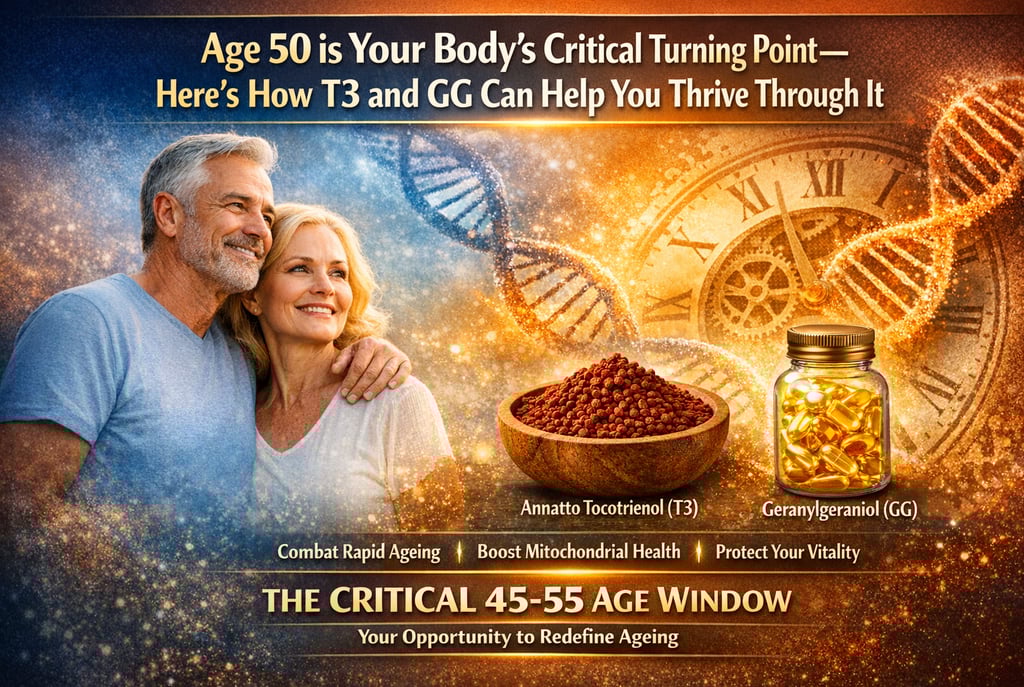
The 45-55 Age Window - Your Critical Opportunity
Recent groundbreaking research has identified ages 45-55 as a "landmark inflection point" where ageing dramatically accelerates across multiple organ systems. This isn't theoretical, scientists have mapped the specific protein changes occurring in 13 different tissues, revealing that most people experience explosive molecular shifts during this decade.
The timing matters enormously. Interventional cardiologist Dr Cheng-Han Chen explained that understanding when ageing accelerates "helps us better understand the types of biochemical changes that underlie ageing and potentially provide targets for therapy at different stages of someone's life". This critical window represents your opportunity to act preventively. Starting supplementation with tocotrienols and GG during ages 45-55 may help mitigate the dramatic protein expression changes that would otherwise accelerate ageing.
Evidence-Based Dosing - What the Research Actually Supports
Don't assume all supplements work equally or require guesswork about dosing. Clinical research provides clear guidance on effective doses.
For tocotrienol: Studies demonstrating cardiovascular and metabolic benefits used doses of 250-500 mg daily of delta-tocotrienol. Research showing mitochondrial improvements used tocotrienol doses equivalent to approximately 100 mg per kg of diet in animal studies. These doses produced measurable improvements in blood pressure, lipid profiles, inflammatory markers, and cellular energy production.
For geranylgeraniol: Animal studies suggesting optimal doses for muscle health and mitochondrial function translate to approximately 170 mg daily for a 70 kg person. This dosing supported muscle preservation, prevented atrophy and protected mitochondrial quality.
Important caveat: Individual needs vary significantly and consultation with your healthcare provider is advisable, particularly if you're taking medications affecting the mevalonate pathway (such as statins). Your practitioner can personalise dosing based on your specific health status and medication interactions.
Building a Comprehensive Strategy - Supplements Are Just One Piece
Whilst T3 and GG address specific ageing mechanisms, they work best within a broader healthy ageing framework. The research emphasises ageing is fundamentally a multi-organ, multi-system process. Dr Manisha Parulekar noted that this research represents "transforming medicine from a reactive, disease-focused model to a proactive, health-focused one".
This means your supplementation strategy should be integrated with:
Regular physical activity: Exercise preserves muscle mass, supports mitochondrial function, and maintains cardiovascular health
Whole-food nutrition: Foods rich in antioxidants, polyphenols and essential nutrients complement supplementation
Stress management: Chronic stress accelerates inflammatory cascades, the very mechanism driving ageing acceleration
Adequate sleep: Cellular repair processes accelerate during sleep
Social connection: Emerging research links social engagement to longevity and reduced chronic inflammation.
Think of T3 and GG as supporting actors in a larger health production, not solo performers. They provide crucial biochemical support, but combined with these lifestyle factors, they're significantly more effective.
The Long Game - Why Patience Matters
Here's a critical insight from the research: the benefits of tocotrienol and GG supplementation typically require sustained use over several months, not days or weeks. The ageing process itself unfolds over decades, and meaningful cellular changes—particularly in mitochondrial function, inflammatory markers, and cardiovascular health—develop progressively.
A revealing study using C. elegans (a model organism for ageing research) found that tocotrienol-rich fraction not only improved stress resistance but significantly extended mean lifespan. However, this longevity benefit emerged from consistent, sustained supplementation, not short-term use. This demonstrates that healthy ageing strategies require commitment over time rather than expecting immediate results.
If you've previously tried T3 or GG but stopped after a few weeks without noticing dramatic changes, reconsider. The research suggests you were likely still in the phase where cellular benefits were accumulating, similar to how cardiovascular training requires weeks to improve your running capacity, even though mitochondrial adaptations are occurring from day one.
A Direct Message to Our Community
For current T3 and GG customers: The convergence of the Cell ageing atlas with mechanistic studies provides scientific validation for your commitment. You're addressing fundamental ageing mechanisms—proteostasis collapse, mitochondrial dysfunction, inflammatory cascades, and vascular ageing—that accelerate dramatically around age 50. Your investment in these supplements targets the exact biological processes driving accelerated ageing during midlife.
For those considering starting: The evidence presents a compelling case. The research identified specific, measurable changes driving ageing acceleration, and multiple studies demonstrate that tocotrienols and GG affect many of these mechanisms through well-characterised biological pathways. Whilst no supplement can stop ageing, evidence suggests T3 and GG may help support your body's natural defence mechanisms during the critical midlife transition when ageing accelerates.
For those who previously tried and stopped: Consider that full benefits require sustained use over months, particularly for effects on mitochondrial function, inflammatory markers, and cardiovascular health. The ageing research emphasises these are progressive, systemic changes requiring long-term support rather than quick fixes. If you stopped too early, restarting with realistic expectations about timeframes may yield the results you didn't observe before.
From Passive Ageing to Active Healthspan Optimisation
The Cell ageing atlas fundamentally transforms how we understand our bodies. By revealing that ageing accelerates dramatically around age 50 through a "molecular cascade storm" affecting multiple organs, this research transforms ageing from an inevitable, gradual decline into a targetable biological process with identifiable mechanisms and intervention points.
Perhaps most importantly, this research reinforces that ageing is not something that simply happens to us, it's a biological process we can potentially modulate through informed choices. By understanding the molecular mechanisms driving ageing acceleration and choosing evidence-based nutritional strategies addressing these mechanisms, you move from passive ageing to active healthspan optimisation.
The goal isn't just living longer; it's, as Dr Parulekar eloquently stated, "compressing morbidity, allowing people to live not just longer, but healthier and more vibrant lives". The convergence of the Cell ageing research with studies on annatto tocotrienols and geranylgeraniol offers both understanding and hope, understanding of what drives accelerated ageing, and hope that targeted nutritional strategies may help you thrive through life's most critical biological transition.
Reference List
Ding, Y., Zuo, Y., Zhang, B., et.al., (2025). Comprehensive human proteome profiles across a 50-year lifespan reveal aging trajectories and signatures. Cell, 188(16), 4423-4444.e20. https://doi.org/10.1016/j.cell.2025.06.047
Medical Xpress. (2025, July 28). Human proteome study maps aging signatures across 13 tissues. https://medicalxpress.com/news/2025-07-human-proteome-aging-signatures.html
Medical News Today. (2025, August 8). Study finds turning point when body starts aging rapidly. https://www.medicalnewstoday.com/articles/study-finds-turning-point-when-body-starts-aging-rapidly
Wang, T., et al. (2020, January 15). A proteomic atlas of senescence-associated secretomes for aging biomarker development. PLOS Biology. https://journals.plos.org/plosbiology/article?id=10.1371/journal.pbio.3000599
Protein Cell. (2025, September 24). A comprehensive multi-organ proteomic atlas of human aging. https://academic.oup.com/proteincell/advance-article/doi/10.1093/procel/pwaf081/8263980
Popular Mechanics. (2025, July 29). Your body starts aging faster after 50—but not all parts at once. https://www.popularmechanics.com/science/health/a65530792/age-acceleration-50/
NAD.com. (2025, September 18). Researchers identify key cellular changes around age 50 that accelerate aging. https://www.nad.com/news/researchers-identify-key-cellular-changes-around-age-50-that-accelerate-aging
American River Nutrition. (2022, December 19). Annatto tocotrienol plus resveratrol may improve cardiometabolic risk in MetS: RCT. https://americanrivernutrition.com/annatto-tocotrienol-plus-resveratrol-may-improve-cardiometabolic-risk-in-mets-rct/
Diaz-Ruiz, A., et al. (2022, November 2). Geranylgeraniol supplementation mitigates soleus muscle atrophy and mitochondrial dysfunction in diabetic rats. PMC. https://pmc.ncbi.nlm.nih.gov/articles/PMC9677755/
Wong, R. S. Y., et al. (2021, September 9). The effect of α-tocopherol, α- and γ-tocotrienols on amyloid-β fibril formation and disaggregation. Journal of Alzheimer's Disease. https://pmc.ncbi.nlm.nih.gov/articles/PMC8435913/
Makpol, S., et al. (2011, March 29). Tocotrienol-rich fraction prevents cell cycle arrest and elongates telomere length in senescent human diploid fibroblasts. Journal of Biomedicine and Biotechnology. https://pmc.ncbi.nlm.nih.gov/articles/PMC3085479/
Natraporn, C., et al. (2018, November 19). Anti-inflammatory activity of tocotrienols in age-related macrophages. Molecules. https://pmc.ncbi.nlm.nih.gov/articles/PMC6247629/
NutraIngredients. (2015, January 7). Clinical trial supports cardiovascular benefits of annatto tocotrienols. https://www.nutraingredients.com/Article/2015/01/08/Clinical-trial-supports-cardiovascular-benefits-of-annatto-tocotrienols/
Fukui, K., et al. (2015, August 1). Dietary tocotrienol/γ-cyclodextrin complex increases mitochondrial membrane potential and ATP concentrations in the brains of aged mice. Journal of Nutritional Science and Vitaminology. https://pmc.ncbi.nlm.nih.gov/articles/PMC4537756/
Nutraceutical Business Review. (2024, December 31). Clinical study confirms cardiovascular benefits of annatto tocotrienols. https://nutraceuticalbusinessreview.com/clinical-study-confirms-cardiovascular-benefits-of-annatto-tocotrienols--104638
Universiti Kebangsaan Malaysia. (2021). Effect of the tocotrienol-rich fraction (TRF) on the lifespan and stress resistance of Caenorhabditis elegans. Sains Malaysiana, 50(2). https://www.ukm.my/jsm/pdf_files/SM-PDF-50-2-2021/14.pdf
Goldstein, M. R., & Mascitelli, L. (2023, November 16). Potential role of geranylgeraniol in managing statin-associated muscle symptoms. Frontiers in Physiology. https://www.frontiersin.org/journals/physiology/articles/10.3389/fphys.2023.1246589/full
Wong, S. K., et al. (2023, February 14). δ-Tocotrienol in combination with resveratrol improves cardiovascular disease risk markers in overweight and obese subjects. Metabolic Syndrome and Related Disorders. https://www.liebertpub.com/doi/10.1089/met.2022.0052