
Boost Cancer Defence with Gut Microbiome Insights
Most people fighting cancer, or trying to prevent its return, focus on what their oncologist prescribes. That makes sense. But a growing body of peer-reviewed research is revealing something extraordinary: the state of your gut microbiome may be just as important to your immune system's ability to find and destroy cancer cells as any drug in the clinic. This post introduces a three-part natural strategy, combining annatto delta-tocotrienol (δ-T3), geranylgeraniol (GG), and a gut bacterium called Akkermansia muciniphila, that research now shows operates through complementary, non-overlapping mechanisms to strengthen the body's cancer defences at multiple levels simultaneously. This is not fringe science. These findings are published in Nature Medicine, Science, and leading oncology journals. And the practical steps to activate all three are simpler than you might expect.
GUT HEALKTHIMMUNE SYSTEMANNATTO TOCOTRIENOLGERANYLGERANIOL (GG)CANCER PREVENTION
Natural Health Connect Research
3/20/202613 min read
Your Gut Is a Cancer Battleground and Most People Don't Know It
Here is something that surprises most people: approximately 70% of the body's immune cells live in and around the gut, forming a surveillance network called the gut-associated lymphoid tissue (GALT). The bacteria in your gut don't just help digest food, they actively train, calibrate, and direct the immune cells that patrol your entire body.
When gut bacteria are depleted or imbalanced, a condition called dysbiosis, immune function deteriorates in ways that directly benefit cancer cells. Tumours exploit dysbiosis to suppress T cell activity, convert macrophages from cancer-killers into cancer-protectors, and build an immune-suppressive microenvironment that shields them from attack.
Restoring specific beneficial bacteria reverses much of this damage and one species, above all others, has emerged from modern microbiome research as a keystone anti-cancer immune regulator.
Meet Akkermansia Muciniphila - The Gatekeeper of Your Anti-Cancer Immunity
Akkermansia muciniphila (AKK) is a bacterium that lives in the mucus layer of your large intestine. In a healthy person, it accounts for roughly 1–4% of total gut bacteria. It is one of the most extensively researched bacteria in modern microbiome science — and its connection to cancer immunity has been described as "groundbreaking" in peer-reviewed reviews.
What does AKK actually do? Current research has identified five distinct mechanisms through which it fights cancer:
1. It Wakes Up Your Killer T Cells
CD8⁺ cytotoxic T lymphocytes — the immune system's designated cancer killers — are enhanced in both number and function by AKK. Studies show AKK increases their infiltration into tumours and boosts IFN-γ secretion (a cytokine critical for cancer cell killing) across multiple cancer types.
2. It Reprogrammes Macrophages from Cancer Protectors to Cancer Killers
Tumours routinely hijack macrophages, flipping them from M1 (anti-tumour) to M2 (pro-tumour) mode. AKK's outer membrane proteins reverse this — driving macrophages back into M1 polarisation and activating the NLRP3 inflammasome, which generates interleukin-1β to restore innate immune attack.
3. It Activates Natural Killer Cells via the STING Pathway
AKK produces a molecule called cyclic diadenylate AMP (cdAMP), a natural STING agonist. This triggers a cascade: type I interferons stimulate NK cells, which release chemokines that recruit dendritic cells, which produce IL-15 to further activate NK cells, creating a self-amplifying anti-tumour immune loop. This matters enormously because NK cells can destroy cancer stem cells (CSC), the treatment-resistant seeds of recurrence, that often evade conventional T cell surveillance.
4. It Directly Kills Cancer Cells
AKK's outer membrane protein Amuc_1434 kills colorectal cancer cells by upregulating TRAIL (tumour-necrosis-factor-related apoptosis-inducing ligand), activating both the death receptor and the mitochondrial apoptosis cascade. A 2025 study published in the FASEB Journal confirmed that Amuc_1434 also enhances CD8⁺ T cell-mediated antitumour immunity directly.
5. It Makes Immunotherapy Work Better - Dramatically!
The most clinically compelling finding involves immune checkpoint inhibitor (ICI) therapy, the class of cancer drugs that includes pembrolizumab (Keytruda) and nivolumab. In a prospective study of 311 non-small-cell lung cancer patients on anti-PD-1 treatment, those with detectable AKK in their gut achieved:
An objective response rate of 28% vs. 18% in AKK-low patients
A median overall survival of 19 months vs. 11.4 months
In front-line immunotherapy, response rates of 41% vs. 19%
These findings, published in Nature Medicine in 2022, have been replicated in melanoma and renal cell carcinoma. AKK abundance is now regarded as one of the strongest predictive biomarkers for immunotherapy response.
The Problem - AKK Is Fragile and Most Australians Are Depleting It
AKK is highly sensitive to modern lifestyle factors. Levels decline significantly with:
Poor diet - low fibre, low polyphenols, high ultra-processed food
Antibiotics - repeated use depletes AKK substantially; recovery can take weeks to months
Chronic stress and elevated cortisol
Metabolic disease - obesity, insulin resistance, and type 2 diabetes all correlate with low AKK
Ageing - unhealthy ageing is associated with AKK decline, though notably, healthy centenarians show elevated AKK levels, suggesting it is lifestyle, not age itself, that depletes it.
The good news? AKK can be deliberately rebuilt and as you will discover below, through some of the most accessible strategies in natural health.
Annatto Delta-Tocotrienol - The Cellular Protector That Also Feeds Your Gut Bacteria
Annatto seeds from the Bixa orellana plant produce the most potent form of vitamin E: delta-tocotrienol (δ-T3). Unlike common alpha-tocopherol (found in most vitamin E supplements), δ-T3 has a distinct molecular structure that allows it to penetrate cell membranes far more rapidly and access molecular targets, including cancer signalling pathways, that tocopherol simply cannot reach.
How δ-T3 Targets Cancer and the Immune System
NF-κB suppression - NF-κB is the master transcription factor cancer cells use to evade immune attack, resist chemotherapy, and promote their own survival. δ-T3 is one of the most potent natural inhibitors of NF-κB activation, reducing pro-inflammatory cytokines and cutting off tumour survival signals in both laboratory and animal models.
PD-L1 disruption - targeting the same mechanism as billion-dollar drugs. In a significant 2024 finding, δ-tocotrienol was shown to disrupt PD-L1 glycosylation, reversing PD-L1-mediated immune suppression. PD-L1 is the protein cancer cells use to "switch off" attacking T cells, it is the precise target of pembrolizumab (Keytruda) and other checkpoint inhibitors. δ-T3 suppresses PD-L1 expression by 35–50%, using a mechanism distinct from pharmaceutical drugs, with a correlated enhancement of tumour-killing T cell activity.
Anti-metastatic and anti-angiogenic activity - δ-T3 inhibits VEGF-driven tumour angiogenesis (the blood supply that feeds tumour growth), reduces epithelial-to-mesenchymal transition (the process cancers use to invade and spread), and targets cancer stem-like cells across multiple cancer types including pancreatic, prostate, melanoma, and liver cancer.
Synergy with chemotherapy: δ-T3 enhances the anti-tumour activity of gemcitabine in pancreatic cancer, with NF-κB suppression identified as the key mechanism. This means it may amplify, rather than interfere with, standard cancer treatment.
The Remarkable Gut Connection - δ-T3 Directly Increases AKK
Here is a finding that fundamentally changes the case for taking annatto tocotrienol and one that most practitioners have not yet encountered.
In a 14-week controlled study, supplementation with annatto-extracted tocotrienol significantly increased the relative abundance of Akkermansia muciniphila in the gut compared to controls. The same treatment decreased the Firmicutes/Bacteroidetes ratio (a key marker of gut dysbiosis), reduced inflammatory markers including resistin, leptin, and IL-6, and improved glucose homeostasis.
Published in Nutrition Research in 2020, this finding means that taking annatto tocotrienol may simultaneously:
Directly attack cancer cells through NF-κB suppression and PD-L1 disruption, AND
Cultivate the gut bacterium that activates the immune system's cancer-fighting cells
This is not a designed effect, it is a naturally occurring synergy that emerged from the research.
Geranylgeraniol (GG) - The Mevalonate Pathway Disruptor
Geranylgeraniol (GG) is a natural isoprenoid compound found in small amounts in olive oil, linseed,and sunflower oil. It is a critical intermediate in the mevalonate pathway of the liver, the same cellular pathway that statin drugs target and it plays a unique dual role, disrupting cancer cell survival while protecting healthy cells from harm.
How GG Fights Cancer
HMG-CoA reductase inhibition: GG inhibits HMG-CoA reductase in tumour cells, blocking the prenylation of Ras and RhoA, small G-proteins that cancer cells depend on for uncontrolled growth, invasion and survival. This is a completely independent mechanism from tocotrienol's NF-κB focus.
Multi-pathway apoptosis induction: GG induces cancer cell death across a broad range of cancers, colon, prostate, breast, lung, liver and pancreatic, through modulation of p53, STAT3 and caspase activation pathways.
Protection of healthy cells: Perhaps most remarkably, GG selectively protects normal cells from the collateral damage of cancer therapies. It mitigates chemotherapy and radiation side effects without blunting anti-tumour effect a property that makes it a compelling adjunct for patients undergoing treatment.
Gut microbiome support: A 2021 study showed that GG supplementation increased Butyricicoccus pullicaecoruma, a butyrate-producing species strongly associated with reduced colorectal cancer risk. When combined with tocotrienol, GG demonstrated prebiotic potential, shifting the gut microbiome toward a composition consistent with better metabolic and immune health.
The Critical Statin Connection
Approximately 3 million Australians take statin medications for cholesterol management. Statins block the mevalonate pathway and in doing so, they deplete the body's endogenous GG (geranylgeranyl pyrophosphate). Research shows this depletion:
Increases the risk of type 2 diabetes by 10–20%
Causes muscle fibre loss (statins reduced muscle fibre by 60% in one study; GG completely restored it)
Impairs insulin sensitivity
For statin users, GG supplementation is not just a cancer-prevention tool, it may help counteract some of the metabolic side effects of their medication.
Why T3 + GG Together Beats Either Alone
Taking δ-T3 and GG together creates a complementary synergy that neither compound achieves independently. Here is how their mechanisms compare across key anti-cancer functions:
Blocking cancer cell survival pathways
δ-Tocotrienol: targets NF-κB and Wnt/β-catenin
GG: targets HMG-CoA reductase, Ras/RhoA, and STAT3
Targeting cancer stem cells (CSCs)
δ-Tocotrienol: suppresses EMT and telomerase activity
GG: blocks mevalonate-dependent CSC proliferation
Activating cytotoxic T cells (CD8⁺)
δ-Tocotrienol: downregulates PD-L1 by 35–50%
GG: supports immune protein production
Supporting gut microbiome
δ-Tocotrienol: directly increases AKK abundance
GG: increases Butyricicoccus and has prebiotic effect
Protecting healthy cells
δ-Tocotrienol: induces cancer-selective apoptosis
GG: directly protects normal cells from therapy damage
The combination has been validated in human prostate carcinoma cell studies, where d-δ-T3 and GG together produced synergistic suppression of growth and HMG-CoA reductase that neither compound achieved alone.
Feeding Akkermansia - What the Science Says About Juices and Diet
AKK thrives on polyphenols — plant compounds found in deeply coloured fruits and berries. These protect AKK from oxidative damage in the gut and provide substrates for its growth. The following have the strongest published evidence:
POMEGRANATE JUICE
Key compounds: Ellagitannins, punicalagins, ellagic acid
Cancer benefits: Directly stimulates AKK growth; suppresses NF-κB and AKT in cancer cells; slows PSA rise in prostate cancer; induces colon cancer cell apoptosis.
CRANBERRY JUICE OR EXTRACT
Key compounds: Type-A proanthocyanidins (PACs)
Cancer benefits: 77% reduction in colon cancer precursor lesions in animal studies; inhibits colon cancer cell viability at 25 µg/mL; anti-tumour and anti-inflammatory properties.
Important note on cranberry juice: Most commercial "cranberry juice drinks" are heavily diluted with added sugar. Look specifically for 100% cranberry juice or cranberry concentrate with no added sweeteners to achieve therapeutic PAC levels.
GRAPE JUICE OR RED WINE
Key compounds: Resveratrol, oligomeric proanthocyanidins (OPCs)
Cancer benefits: In animal models, grape polyphenols increased AKK from approximately 6% to 49% of the gut microbiome. Resveratrol inhibits NF-κB and STAT3.
GREEN TEA (2–3 cups daily)
Key compounds: EGCG (epigallocatechin gallate)
Cancer benefits: Directly encourages AKK growth; EGCG enhances CD4⁺ T cell activity and NK cell cytotoxic killing in vivo; inhibits multiple cancer signalling pathways including NF-κB, PI3K-AKT, JAK-STAT, and EGFR.
Brew fresh - bottled and heat-processed green tea loses most of its EGCG content.
BLUEBERRY JUICE
Key compounds: Anthocyanins, chlorogenic acid, resveratrol
Cancer benefits: Antioxidant and anti-inflammatory; supports AKK growth; associated with reduced lung, breast, and colon cancer risk in research studies.
Practical daily target: 150–250 mL of pomegranate or cranberry juice (unsweetened), plus 2–3 cups of brewed green tea. These are compatible with tocotrienol and GG supplementation and can be spread across the day.
Beyond Juice - Other Proven AKK-Boosting Strategies
Intermittent fasting (14–18 hour window): One of the most powerful AKK promoters known. In a controlled study, AKK increased in more than 83% of young and 74% of middle-aged volunteers, with typical increases of 1.5–5 fold. AKK is uniquely adapted to use intestinal mucins as an energy source during fasting, giving it a competitive advantage when dietary substrates are reduced.
Prebiotic foods: Garlic, leeks, chicory root, Jerusalem artichoke, and asparagus contain fructooligosaccharides (FOS) and inulin, among the most effective substrates for AKK proliferation.
Mediterranean-style diet: Consistently associated with higher AKK abundance and better anti-PD-L1 immunotherapy response rates in cancer research.
Pasteurised AKK supplementation: Now available commercially and approved as a Novel Food in Europe. Clinical trials show improvements in insulin sensitivity, body composition, and inflammatory markers — and emerging data suggest synergy with immunotherapy.
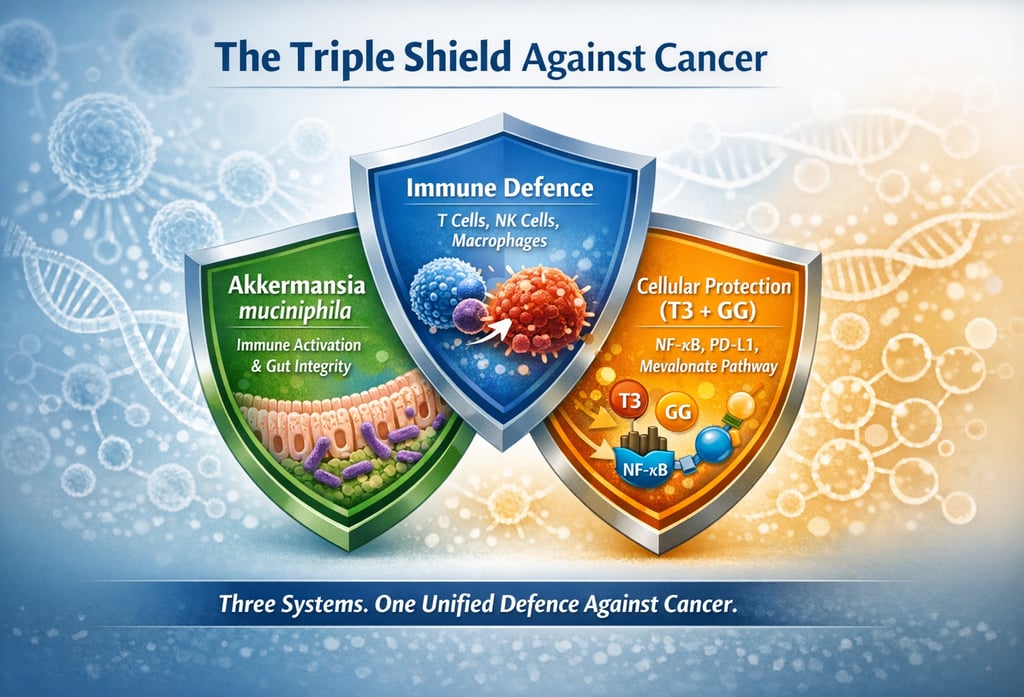
The Three Together - A Converging Defence at Three Levels
What makes the δ-T3 + GG + AKK combination scientifically compelling is that each operates at a different anatomical level, yet they converge on the same targets:
δ-T3 and GG work inside and around cancer cells, targeting the molecular machinery cancer cells use to survive, evade the immune system and resist treatment. They suppress NF-κB and PD-L1 (δ-T3) and disrupt the mevalonate pathway and Ras/STAT3 signalling (GG).
AKK works at the gut–immune interface, training and mobilising the immune cells (T cells, NK cells, macrophages) that are then deployed systemically to find and destroy cancer cells, including at distant tumour sites.
Polyphenol juices fuel AKK daily while simultaneously delivering their own anti-cancer polyphenols, adding a fourth layer of NF-κB suppression and angiogenesis inhibition.
The fact that annatto tocotrienol supplementation itself increases AKK is the scientific glue that transforms this from three independent interventions into one integrated, self-reinforcing strategy.
The Science-Backed Daily Protocol
This protocol is designed to be practical, low-cost, and grounded in the published evidence. Always consult your healthcare professional before making changes, particularly if you are receiving cancer treatment.
With breakfast:
Annatto δ-tocotrienol supplement (see dosage guidelines - visit our Dosage page)
GG supplement (taken with T3 for combined gut and anti-cancer benefit)
150 mL unsweetened pomegranate or cranberry juice
Through the day:
2–3 cups of brewed green tea (avoid bottled green tea, heat-processed versions lose most EGCG)
Plant-forward meals: legumes, leafy greens, wholegrains, olive oil, oily fish
Weekly:
Fresh or frozen blueberries, grapes, or mixed berries 4–5 times
Prebiotic foods: garlic, leeks, chicory, Jerusalem artichoke, asparagus
Optional but powerful:
Time-restricted eating with a 14–16 hour overnight fasting window. one of the simplest and most effective AKK-boosting strategies available
Pasteurised AKK probiotic supplement, particularly after any course of antibiotics
An Honest Note on the Evidence
The mechanisms described in this article are supported by a strong body of preclinical evidence and growing human clinical data, particularly the immunotherapy response data for AKK, the PD-L1 disruption data for δ-T3, and the gut microbiome data linking T3 supplementation to AKK increase.
However, large randomised controlled trials testing this specific three-way combination against cancer recurrence have not yet been conducted. The case for this approach rests on the strength of the mechanistic science, the established safety profiles of each compound and the favourable risk-benefit ratio, these are not high-risk, high-cost interventions.
The potential upside, a meaningfully strengthened immune defence operating through multiple independent, non-overlapping pathways, is scientifically plausible and consistent with the best available published evidence.
Conclusion - Your Body's Defences Are Waiting to Be Activated
Your immune system already has the machinery to find and destroy cancer cells. δ-Tocotrienol, geranylgeraniol, and Akkermansia muciniphila don't replace that machinery, they help it operate at its full potential, every day.
A glass of pomegranate juice. A cup of green tea. An annatto T3+GG supplement with breakfast. A 14-hour fasting window overnight. These are not heroic interventions. They are daily habits, grounded in science, that steadily stack the evidence in your favour.
This article is intended for educational and informational purposes only and does not constitute medical advice. It is not intended to diagnose, treat, cure, or prevent any disease or medical condition. Always consult a qualified healthcare professional before making changes to your supplement, medication, diet, or health regimen.
Explore further on Natural Health Connect:
Scientific References
Li, X., et al. (2022). Gut microbiome in modulating immune checkpoint inhibitors. EBioMedicine 2022. https://pubmed.ncbi.nlm.nih.gov/35841869/
Wu, J., et al. (2021). Modulation of gut microbiota to enhance effect of checkpoint inhibitor immunotherapy. Frontiers in Immunology, 12, 669150. https://www.frontiersin.org/journals/immunology/articles/10.3389/fimmu.2021.669150/full
Fan, S., et al. (2023). Akkermansia muciniphila: a potential booster to improve the effectiveness of cancer immunotherapy. Journal of Cancer Research and Clinical Oncology, 149(14), 13477–13494. https://pmc.ncbi.nlm.nih.gov/articles/PMC12806543/
Chen X, et al., IMetaOmic 2025. The role of Akkermansia muciniphila in cancer: Mechanisms, therapeutic potential, and challenges13, 1230329. https://pmc.ncbi.nlm.nih.gov/articles/PMC10471832/
Khalili., L., et al. Gut Patho (2026). Modulatory role of Akkermansia muciniphila in cancer pathophysiology: a systematic review and meta-analysis of preclinical studies https://pubmed.ncbi.nlm.nih.gov/41546128/
Yang, Y., et al. (2025). Big lessons from the little Akkermansia muciniphila in hepatocellular carcinoma. Frontiers in Immunology, 16, 1524563.
Zhu, J., et al. (2025). Amuc_1434 from Akkermansia muciniphila enhances CD8⁺ T cell-mediated antitumour immunity in colorectal cancer. FASEB Journal. https://pubmed.ncbi.nlm.nih.gov/40231387/
Derosa, L., et al. (2022). Intestinal Akkermansia muciniphila predicts clinical response to PD-1 blockade in advanced non-small-cell lung cancer. Nature Medicine, 28, 315–324. https://pmc.ncbi.nlm.nih.gov/articles/PMC9330544/
Barragan-Carrillo, R., et al. J Clin Oncol (2025). Microbiome modulation for the treatment of solid neoplasms. https://pubmed.ncbi.nlm.nih.gov/40644647/
Ling, M.T., et al. (2012). Tocotrienol as a potential anticancer agent. Carcinogenesis, 33(2), 233–239. https://pubmed.ncbi.nlm.nih.gov/22095072/
Khalid, A.Q., et al. (2025). Insights into the anticancer mechanisms modulated by delta and gamma tocotrienol in Colorectal Cancers. Nutrition Reviews, Volume 83, Issue 3, March 2025. https://academic.oup.com/nutritionreviews/article/83/3/e1295/7740771
Nasir, N.A.A., et al. (2021). Modulation of NF-κB signalling pathway by tocotrienol. Asia Pacific Journal of Clinical Nutrition, 30(4), 537–555. https://apjcn.qdu.edu.cn/PDF20_2021-0165_537_555.pdf
Sun, Z., et al. (2024). Delta-tocotrienol disrupts PD-L1 glycosylation and reverses PD-L1-mediated immune suppression. Biomedicine & Pharmacotherapy, 170, 116078. https://pubmed.ncbi.nlm.nih.gov/38159375/
Sun, Z., et al. (2025). δ-Tocotrienol potentiates breast and prostate cancer cells to paclitaxel via suppressing PD-L1-mediated signalling. Chemical Biology & Drug Design, 105(6), e70143. https://pubmed.ncbi.nlm.nih.gov/40504774/
Husain, K., et al. (2011). Vitamin E δ-tocotrienol augments the antitumor activity of gemcitabine and suppresses NF-κB in pancreatic cancer. Molecular Cancer Therapeutics, 12(12), 2537–2549. https://pubmed.ncbi.nlm.nih.gov/21971120/
Chung, E., et al. (2020). Metabolic benefits of annatto-extracted tocotrienol on glucose homeostasis, inflammation, and gut microbiome. Nutrition Research, 77, 97–107. https://pubmed.ncbi.nlm.nih.gov/32438021/
Fernandes, N.V., et al. (2013). Geranylgeraniol suppresses the viability of human DU145 prostate carcinoma cells and HMG CoA reductase. Exp Biol Med (Maywood). 2013. https://pmc.ncbi.nlm.nih.gov/articles/PMC4010193/
Ammar, R.B., et al. (2023). Potential effects of geraniol on cancer and inflammation. Molecules, 28(6), 2587. https://pubmed.ncbi.nlm.nih.gov/37175079/
Yeganehjoo, H., et al. (2017). Synergistic impact of d-δ-tocotrienol and geranylgeraniol on the growth and HMG CoA reductase of human DU145 prostate carcinoma cells. Nutrition and Cancer, 69(4), 682–691. https://pubmed.ncbi.nlm.nih.gov/28362175/
Chung, E., et al. (2022). Beneficial effect of dietary geranylgeraniol on glucose homeostasis, inflammation, and gut microbiome in obese mice. Nutrition Res.. https://pmc.ncbi.nlm.nih.gov/articles/PMC8464510/
Elmassry, M.M., et al. (2020). Supplementation of geranylgeraniol and tocotrienols to high-fat diet shifts the gut microbiome in type 2 diabetic mice. Nutrients, 12(5), 1333. https://pmc.ncbi.nlm.nih.gov/articles/PMC7258157/
Cani, P.D., et al. (2016). Triggering Akkermansia with dietary polyphenols. Gut Microbes, 7(2), 146–153. https://pmc.ncbi.nlm.nih.gov/articles/PMC4856456/
Heber, D. (2008). Multitargeted therapy of cancer by ellagitannins. Cancer Letters, 269(2), 262–268. https://pubmed.ncbi.nlm.nih.gov/18468784/
Turrini, E., et al. (2015). Potential effects of pomegranate polyphenols in cancer prevention and therapy. Oxidative Medicine and Cellular Longevity, 2015, 938475. https://pmc.ncbi.nlm.nih.gov/articles/PMC4477247/
Sharma, P., et al. (2017). Pomegranate for prevention and treatment of cancer. Molecules.
Weh, K.M., et al. (2016). Cranberries and cancer: an update of preclinical studies. Antioxidants, 5(3), 27. https://pubmed.ncbi.nlm.nih.gov/27548236/
American Institute for Cancer Research. (2023). Cranberries and cancer prevention. https://www.aicr.org/cancer-prevention/food-facts/cranberries/
Zhou, K., (2017). Strategies to promote abundance of Akkermansia muciniphila. Journal of Functional Foods, 57, 466–477. https://pubmed.ncbi.nlm.nih.gov/30416539/
Jeong, H.W., et al. (2020). Green tea encourages growth of Akkermansia muciniphila. Journal of Medicinal Food, 23(8), 841–851. https://pubmed.ncbi.nlm.nih.gov/32598202/
Kciuk, M., et al. (2023). Epigallocatechin-3-gallate therapeutic potential in cancer: mechanisms and clinical perspectives. Molecules, 12, 845145. https://pmc.ncbi.nlm.nih.gov/articles/PMC10343677/
Li, L., et al. (2024). The roles of epigallocatechin gallate in the tumor microenvironment, metabolic reprogramming, and immunotherapy Frontiers in Immunology, 14, 1123346. https://www.frontiersin.org/journals/immunology/articles/10.3389/fimmu.2024.1331641/full
Neto, C., (2007). Cranberry and blueberry: evidence for protective effects against cancer and vascular diseases. Molecular Nutrition & Food. https://www.semanticscholar.org/paper/Cranberry-and-blueberry%3A-evidence-for-protective-Neto/04c6ee6718285755af4f8803d7fc802fd7d94b99
Su, J., et al. (2022). Intermittent fasting and Akkermansia muciniphila potentiate immune checkpoint blockade efficacy. Front Pharmacol. https://pmc.ncbi.nlm.nih.gov/articles/PMC8874811/
Özkul, C., et al. (2019). Islamic fasting leads to an increased abundance of Akkermansia muciniphila: a preliminary study on intermittent fasting. Turkish Journal of Gastroenterology, 30(12), 1030–1035. https://pubmed.ncbi.nlm.nih.gov/31854308
Qu., L.,et al. (2025). Therapeutic effects of pasteurized Akkermansia muciniphila on metabolic and behavioral dysregulation in a zebrafish model of type 2 diabetes mellitus comorbid with depression Journal of Functional Foods https://www.sciencedirect.com/science/article/pii/S1756464625001902